
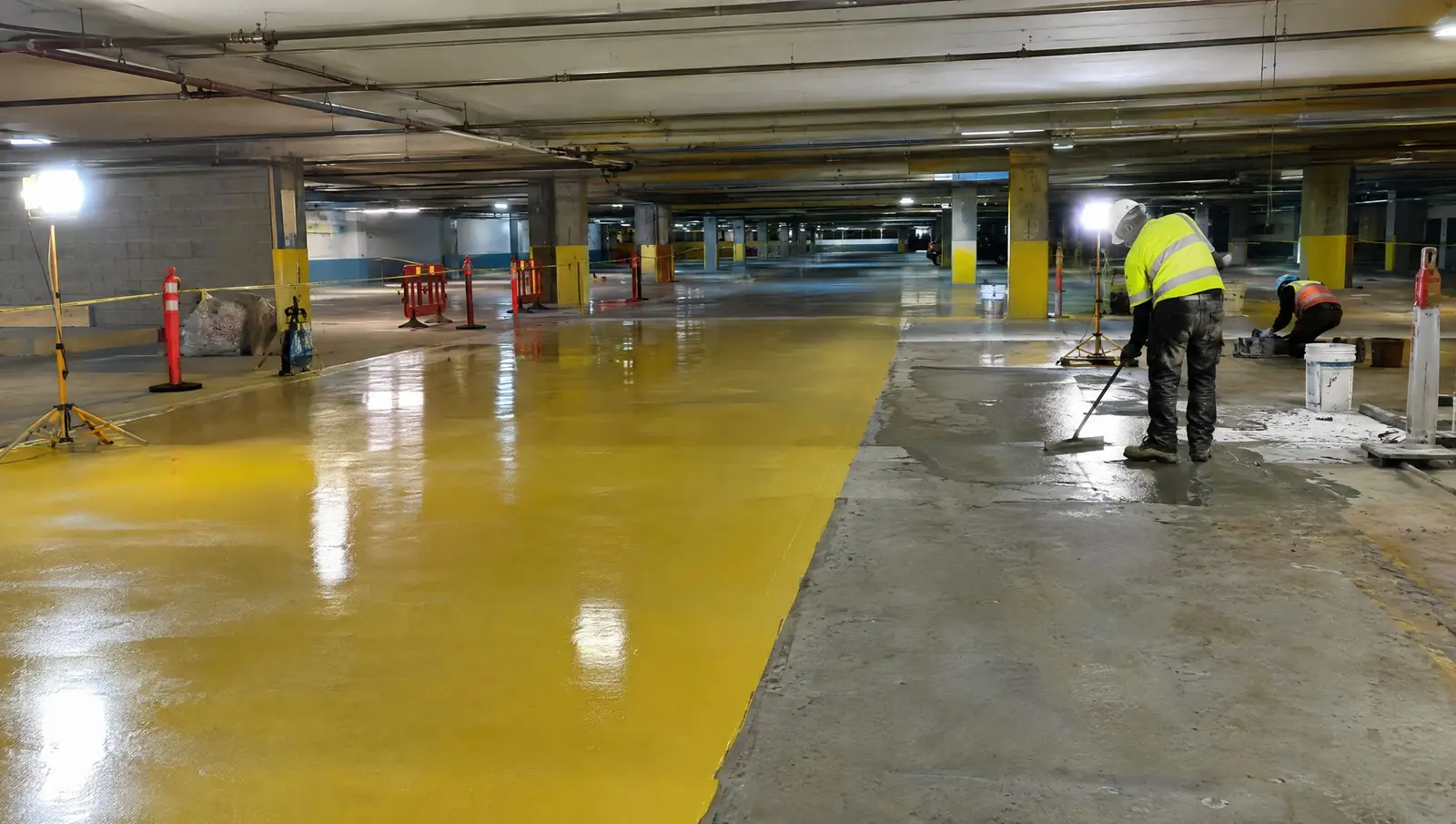
Parking garage salt damage starts when road salt, carried in on vehicles or washed down from ramps and plazas, dissolves in melt water and soaks into the concrete. The chloride reaches the reinforcing steel, breaks down the protective film around it, and the steel begins to rust. Rust takes up more space than steel, so it cracks and pushes off the concrete around it, and leaks follow. This guide explains how the damage progresses, what to look for, what prevention is realistic, what repair involves and when a condo board should bring in an engineer.
Key takeaways
- Salt itself does not eat concrete quickly. The main damage is indirect: chloride in salt water reaches the rebar, the rebar rusts, and the expanding rust cracks and spalls the concrete.
- The warning signs are rust stains, hairline and map cracking, white deposits, dripping from the underside of slabs, ponding water, spalled concrete and exposed rebar.
- Prevention works best when it is steady and boring: working drains, sound joints, an intact traffic membrane, prompt removal of slush and a spring wash-down that sends water where it is allowed to go.
- Once concrete is delaminating or steel is exposed, the garage is a structural question. Retain an engineer for a condition survey, and put the findings into the reserve fund study.
How does de-icing salt damage a condo parking garage?
Salt damages a condo garage in a chain of steps rather than in a single event. Winter road salt and slush collect on vehicles, drip off in the garage and are carried down ramps. Salt-laden water also seeps in from plazas, entrances and landscaped areas above. The water carries dissolved chloride into small cracks, joints and the pores of the concrete. When enough chloride reaches the steel reinforcement, the thin protective film that normally keeps the steel from rusting breaks down. The steel then corrodes, the rust expands, and the concrete around it cracks, delaminates and eventually breaks away.
That chain is why the problem is easy to underestimate. The visible symptoms often appear years after the chloride arrived, and by then the damage is under the surface. A board that treats a stained ceiling or a patch of flaking concrete as a cosmetic issue may be looking at the late stage of a process that started in the first few winters. Our overview of parking garage restoration in Toronto describes the repair side. This guide focuses on how the salt gets in, how to recognize the damage and what a board can do about it.
How does salt-laden water reach the slabs?
Most of the salt in an underground or podium garage arrives with the vehicles. Cars and trucks pick up slush and brine on Toronto streets, drive down the ramp and park, and the melt water drips onto the floor. The salt stays behind when the water dries, so residue builds up in the same stalls and aisles each winter. Cold, wet and dry cycles repeat all season, which keeps pushing the dissolved chloride deeper.
The second route is water from above. Plazas, planters, driveways and entrances sit over many garages. When the waterproofing on those surfaces fails, salted melt water travels through the roof slab and appears as drips, stains and white deposits on the ceiling below. In that case the garage is only showing the symptom, and the repair has to include the source. The same logic applies to balconies and terraces, which is why our guide to freeze-thaw damage on condo exteriors treats water entry as the root cause of most envelope problems.
Concrete is not waterproof. It is porous, and cracks form in every structure as it carries loads and moves with temperature. Cracks, cold joints and failed expansion joints give water a direct path. The amount of concrete between the surface and the steel, called the cover, also matters. Where cover is thin, or where the concrete is of poor quality, chloride reaches the steel sooner. The table below shows where the damage tends to start in a typical garage.
| Location in the garage | How salt gets there | What tends to go wrong | What to look for |
|---|---|---|---|
| Drive aisles and ramps | Dripping slush and brine from vehicles, plus salt applied at the entrance | Salt water sits in cracks and low spots, and the surface and top steel are exposed | White residue, map cracking, surface scaling, ponding after wet days |
| Underside of upper slabs and plaza slabs | Water and salt from above passing through cracks and failed waterproofing | Leaks, efflorescence and corrosion of the bottom steel | Stalactite-like deposits, damp patches, rust streaks, dripping onto vehicles |
| Expansion and control joints | Joint sealant has aged or been damaged, so water passes straight through | Leaks at the joint line, and corrosion on the nearby concrete and steel | Gaps or torn sealant, staining below the joint, wet lines in rain or thaw |
| Columns, walls and curbs near traffic | Splash and spray from vehicles and from wash water | Corrosion at the base of columns, where cover is often thin | Rust stains, cracks that follow the bars, spalling at the base |
| Floor drains and low areas | Water collects and evaporates, leaving a concentrated salt crust | Standing salt water, plus blocked drains that keep the surface wet | Crusted salt rings, slow-draining water, soft or scaling concrete |
Each row is one version of the same process. Water carries salt in, the salt stays, and the concrete and steel have no easy way to dry out.
What are chloride and rebar corrosion, in plain terms?
Concrete is strongly alkaline. That alkalinity creates a thin passive film around the embedded steel bars, and while the film is intact the steel is protected. Chloride ions from de-icing salt can break that film down once enough of them reach the bar. Without the film, steel in the presence of moisture and oxygen begins to corrode. The Construction Specifier's overview of reinforcement corrosion in parking structures explains this process and notes that stains, hairline cracking, standing water and accumulated de-icing chemicals can be early warning signs of conditions that favour corrosion.
The reason this matters physically is that rust takes up more volume than the steel it came from. The expansion creates internal pressure. First the concrete develops hairline cracks that follow the line of the bar. Then the cracks open, the layer of concrete over the bar separates from the rest (delamination), and finally pieces fall away. This is the spalling that gives a deteriorating garage its patched, broken look. The same sequence plays out on balconies, and our guide to spalling and rust stains on balconies shows what it looks like on a smaller scale.
Two points are worth keeping in mind. First, corrosion is not uniform. It is concentrated where water and chloride collect, so a garage can have severe damage in a few zones and almost none elsewhere. That is why a condition survey samples across the whole structure. Second, once chloride has reached the steel at a given location, the corrosion can continue even if the surface is sealed afterwards. Sealing helps to slow new chloride entering, but it does not remove chloride that is already in the concrete. An engineer designs around both facts.
What are the signs of salt damage to look for?
A manager or board member can spot most of the early signs on a walk through the garage after a wet or thawing day. Nothing here replaces an engineer's survey, but it tells you when to ask for one. Look for these signs, roughly in order from early to late:
- White deposits (efflorescence). Mineral salts left behind where water has moved through the concrete and evaporated. It shows that water is passing through the slab, joint or wall.
- Rust stains and streaks. Orange or brown marks on the concrete, often along a line where a bar sits, point to corrosion beneath the surface.
- Hairline and map cracking. Fine cracks that follow the bar lines, or a network of cracks on the surface, can indicate expansive pressure or surface damage.
- Leaks and dripping from the underside of slabs. This shows a failed waterproofing layer, a leaking joint or a crack, and the water is carrying salt with it.
- Ponding and slow drainage. Standing water keeps the surface wet and keeps salt in contact with the concrete.
- Spalled concrete and exposed rebar. Pieces missing from the surface, with bars visible and rusted. At this stage the damage is advanced.
- Hollow sounds. When an engineer taps or tests the concrete, a hollow response indicates delamination that cannot be seen on the surface.
Take dated photos in the same locations each spring. A series of photos over several years gives the engineer a record of how fast things are changing, and it helps the board explain the issue to owners when a budget is requested.
What prevention is realistic for a condo corporation?
Prevention is mostly about keeping water moving out and keeping salt from sitting on the concrete. None of it removes the need for periodic repairs, but it slows the cycle and makes the repairs smaller. The most useful measures are practical ones:
- Keep the drainage working. Check floor drains and trench drains for debris, and make sure water actually reaches them. Water that has nowhere to go sits on the slab and carries salt into it.
- Maintain joints and cracks. Replace failed joint sealant and seal active cracks before water passes through. This is cheaper than repairing the slab and steel after leaks have run for several winters.
- Protect the surface. Traffic-grade membranes and sealers on drive aisles and ramps are designed to keep water and chloride out of the slab. They need inspection and repair, and the engineer should specify them for the garage's conditions. Our guide to balcony waterproofing systems compares the main membrane families, which are broadly the same ones used on traffic decks.
- Remove slush and salt residue. Where it is practical, sweep or squeegee slush and salt build-up toward the drains during the winter instead of leaving it to dry in place.
- Wash the garage in spring. A scheduled wash-down in spring removes the winter's salt residue before it can keep working into the concrete. Confirm where wash water is permitted to drain, and check with the building's engineer or the City before starting a program, since drainage rules vary.
- Manage the salt you apply. If the corporation applies de-icer at ramps and entrances, use it sparingly, and discuss alternatives and application rates with the engineer. Environment and Climate Change Canada publishes a code of practice on road salt management. It is written for public road authorities and does not cover private parking lots, so condo corporations have to set their own approach.
- Look after the plaza above. If the garage sits under a plaza or landscaped area, keep the drainage and waterproofing there in good order, since failures above show up as leaks below.
What does repair of salt-damaged garage concrete involve?
Repair is designed by an engineer and carried out in a sequence. The details differ by garage, but a typical program includes some or all of the following steps:
- Condition survey. The engineer inspects the structure, sounds the concrete for delamination, maps cracks and leaks, and may take cores or samples to test for chloride content and concrete quality.
- Concrete removal. Loose and delaminated concrete is removed back to sound material. The extent depends on the survey, and it often goes further than the visible damage.
- Steel treatment. Rusted bars are cleaned and treated. Where bars have lost significant section, the engineer may require them to be supplemented or replaced.
- Concrete repair. Repair material is placed and finished to match the surrounding slab. Compatibility between the repair material and the old concrete matters, because mismatched repairs can set up new corrosion around their edges.
- Crack injection and joints. Active leaks are sealed by injecting cracks and by replacing failed joint sealants and expansion joint assemblies.
- Waterproofing and drainage. A traffic membrane is installed on drive surfaces, and drains and slopes are corrected so water leaves the structure.
- Corrosion protection, where specified. Some designs add protective measures, such as coatings on the steel or galvanic anodes placed in the repair areas. These are engineering choices based on the survey results.
Garage work affects residents, so a phasing plan matters as much as the concrete. Work is usually planned in zones, with temporary parking arrangements and notices to owners, and some products need ventilation and a closed area while they cure. A contractor experienced in condo exterior restoration and garage work will coordinate those steps with the engineer and the property manager. Our winter restoration guide also explains why many coatings and repair products need mild, dry conditions, which is why garage programs are often scheduled for the warmer months.
When should a board involve an engineer?
A garage is a structure, and structural questions belong to an engineer. Bring one in when any of the following is true: concrete is spalling or falling, rebar is exposed, cracks are widening or appearing in beams, columns or slab edges, water is leaking through the slab in several places, or the corporation has no recent condition survey. An engineer can also tell you which findings are urgent and which can be planned over several years.
Engineers decide what needs repair, to what extent and with which materials. The contractor then carries out that scope. Keeping those roles separate also makes it easier to compare bids, which is covered in our guide to hiring a condo restoration contractor.
The findings should feed the budget. A garage program can be one of the larger items in a long-term plan, and the corporation should not wait for a failure to find out what it will cost. Our guide to the reserve fund study in Ontario condos explains how engineering findings turn into component schedules and funding recommendations, so that repairs are planned and funded in advance, not raised as a surprise special assessment. If you are not sure where your garage stands, send us the building address and we can arrange a site visit and talk through the next step with your engineer.
One last point on safety. If a board member or resident sees concrete falling, large pieces hanging from a slab, or sudden new cracking, the area should be closed off and the engineer called the same day. Do not wait for the annual inspection.
Sources and further reading
- Treating reinforcement corrosion in parking structures (The Construction Specifier)
- Code of practice for the environmental management of road salts (Government of Canada)
- Canadian Condominium Institute: Maintenance and Repairs
- Condominium Act, 1998 (Ontario e-Laws)