Last updated
Balcony railing replacement in Toronto is the removal of rusted or outdated guards and the installation of modern glass or aluminum systems anchored to repaired concrete and built to Ontario Building Code requirements. CondoWorks coordinates replacement with slab repair and waterproofing.
Old balcony guards are often the first thing that makes a building look dated, and sometimes the first thing that is unsafe. Welded steel rails rust at the base and at post connections. Fasteners loosen. Pickets with wide spacing or climbable horizontal rails no longer match current safety expectations.
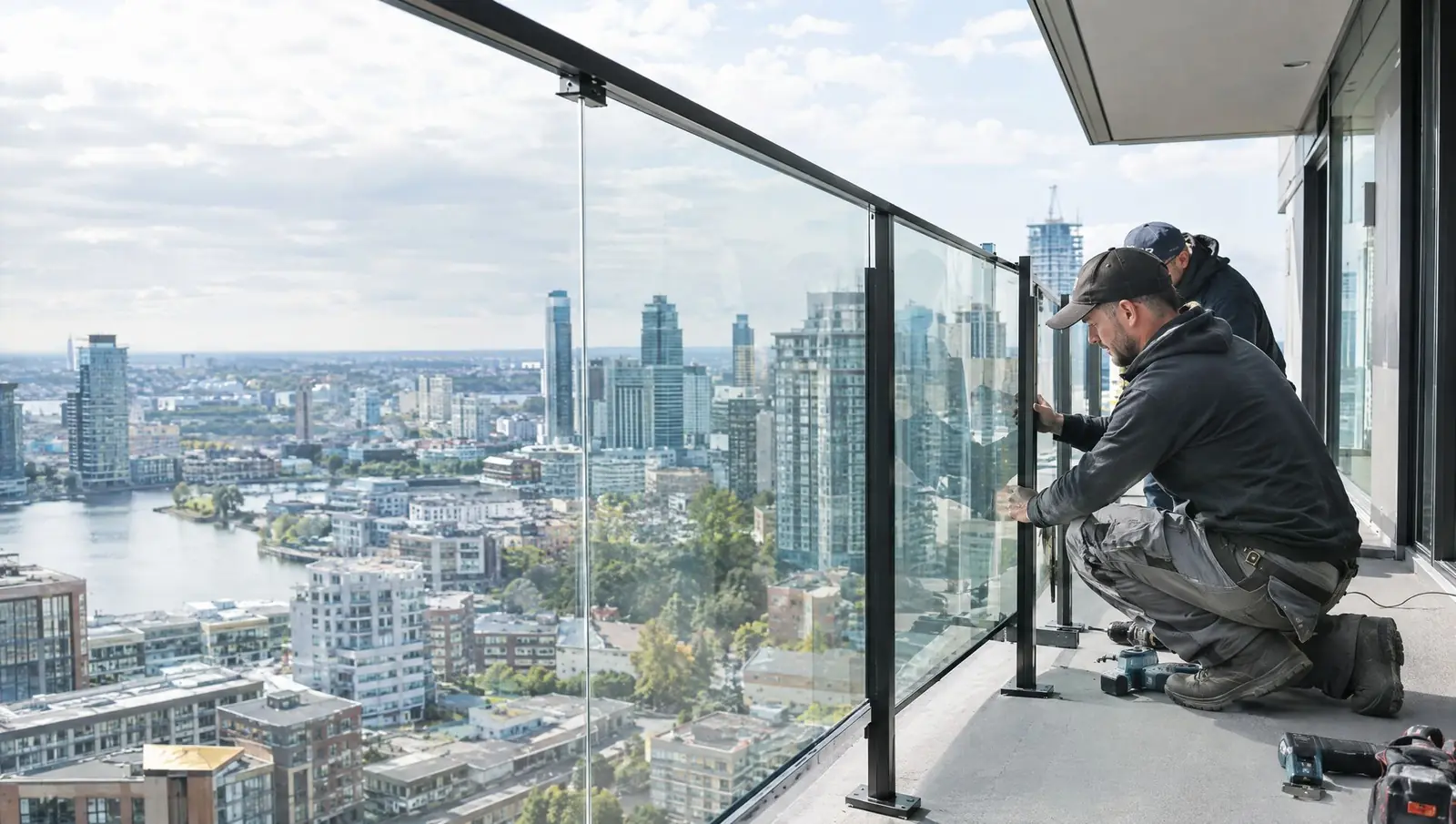
A replacement program swaps the old guard for a modern system. Glass panels in aluminum channels give an open, contemporary look. Powder-coated aluminum pickets offer a lower cost, low-maintenance alternative. Either system is anchored to sound concrete and sealed against water.
Anchoring is the critical detail. Posts must be set into repaired concrete with corrosion-resistant fasteners, so railing replacement is almost always combined with slab-edge repair and waterproofing.
What does balcony railing replacement in Toronto include?
- Removal and disposal of old guards
- Slab-edge repair for sound anchorage
- Glass panel or aluminum picket systems in standard and custom colours
- Stainless or corrosion-resistant fasteners and anchors
- Sealant and flashing at post bases
- Engineer's design or review where required
Choosing a system
Framed glass
Clear sightlines, easy to clean, premium appearance. Higher cost than aluminum.
Aluminum pickets
Durable, economical, available in a range of powder-coat colours.
Hybrid
Glass on street elevations and aluminum on service sides to balance cost and appearance.
How balcony railing replacement works, step by step
Measure and design
Survey every balcony and confirm design with the engineer and board.Approvals
Colour, glazing and sample approved by the corporation.Remove
Take out old guards, prepare anchor points.Install
Anchor, level, glaze and seal.Inspect
Load checks, fastener review and sign-off.
When a guard needs replacing, not repairing
Old balcony guards may be tolerable for years, but there are clear signs they have reached the end of their life. Rust at the base of posts and at welds is the most common. Loose or wobbling posts indicate failing anchors or deteriorated concrete. Missing or bent pickets, peeling paint that returns every year, and designs that a child could climb are also reasons to replace, rather than keep repainting.
Guards are safety devices. Their purpose is to prevent falls, and that requires adequate height, strength, and small enough openings. Standards for guards have changed over the decades, so a guard that was acceptable when the building was built may not match what the Ontario Building Code requires of a new installation. A qualified engineer can advise what the building needs and what the corporation must do when it replaces them.
Glass versus aluminum: how to choose
Most replacement programs end up choosing between framed glass and aluminum pickets. Both can be engineered for high-rise use. Here is how they compare in practice:
- Appearance. Glass keeps sightlines open and feels contemporary. Aluminum pickets give a clean, vertical rhythm and can be coloured to match window frames.
- Privacy and wind. Clear glass offers no privacy, though frosted or tinted options exist. Solid glass also catches wind, which affects design on tall buildings.
- Maintenance. Glass needs regular cleaning. Aluminum is lower effort, though powder coat can mark.
- Cost. Aluminum is generally the more economical system, with glass higher because of materials and installation.
- Safety glazing. Glass must be tempered or laminated and specified for the loads and wind pressure on the particular building.
We bring samples to board meetings where useful, and we help the corporation choose one design for the whole building so appearance is consistent from the street.
Anchoring: the detail that decides longevity
A beautiful guard is only as good as its connection to the slab. Most failures happen at the anchors, not the guard itself. Proper anchorage depends on sound concrete, correct embedment and edge distance, corrosion-resistant fasteners and a seal that keeps water from collecting around the base.
Where the slab edge is cracked or spalled, we repair it first. Posts may be face-mounted or top-mounted depending on the slab geometry, and the anchoring method is chosen by the engineer for the loads involved. We use stainless steel or similarly protected hardware, install flashing or sealing boots at each post and test the installation. Where required, an engineer inspects the first installations and a sample of the rest to confirm they meet the design.
Approvals, code and scheduling
Guard replacement is regulated work. The design and installation need to satisfy Ontario Building Code requirements for guards, and for a high-rise this normally involves an engineer's drawings and sometimes a building permit. The corporation will also require approval of the design, colour and installation method, often by a board vote.
Fabrication of custom aluminum and glass guards takes weeks, so approvals and shop drawings should be completed well ahead of the work season. Once components arrive, installation is relatively quick. We coordinate the installation sequence with slab repair and waterproofing so that the guards are not installed over areas that still need repair, and so the membrane is flashed properly around the new posts.
Residents are notified about access, because the balcony will be closed for the period the old guard is removed and the new one installed. Temporary protection is installed so no opening is left unguarded.
Temporary safety during replacement
Removing a guard leaves a balcony open to a fall hazard. We schedule replacement so that each balcony is closed and secured whenever the guard is not in place, using temporary barriers and locked doors where required. Residents are told not to use the balcony until the work is complete and inspected, and building management is informed of each day's work areas. Falling-object protection is set up below the working area to protect people on the ground.
Design details that make a new guard look finished
The difference between an average and a good installation is in the details. Consistent post spacing and alignment along each elevation, level top rails following the slab slope, matched finishes across all balconies, tidy base covers and clean sealant lines make the building look intentional. For glass guards, edge treatment, glazing gaskets, hardware finish and handrails influence both appearance and safety. For aluminum systems, the choice of picket spacing, post profile and colour affects how light and views come through.
Corner balconies, curved slabs and wraparound units require custom detailing, and each needs measuring on site, because slabs are rarely perfectly square. We take field dimensions, build shop drawings, and check fit before fabrication. This reduces rework and ensures the installation matches the approved drawings.
Maintenance of new guards
New guards are low maintenance but not maintenance-free. Glass needs periodic cleaning with non-abrasive products, and gaskets and sealants should be inspected annually. Aluminum benefits from rinsing to remove salt and dirt, and powder-coated finishes should be checked for chips, which can be touched up. Fasteners and base seals should be inspected at regular intervals, especially after harsh winters. We provide a short maintenance guide for the corporation and, if requested, an inspection program that identifies minor issues before they become expensive.
Questions for boards considering guard replacement
A guard program is a long-term decision, so boards should ask:
- Who is designing and reviewing the system? An engineer should confirm loads, anchors and code.
- How will the guards be anchored? Anchors in sound, repaired concrete matter most.
- What are the maintenance requirements? Glass and aluminum differ in cleaning and recoating.
- What is the lead time for fabrication? Custom systems take weeks, so plan the season.
- How will balconies be secured during replacement? No opening should be left unguarded.
- What warranty applies? Get terms for materials, finish and installation.
The short version
Replacing balcony guards is a safety upgrade and a visual one. The decision comes down to the design of the system, the quality of the anchorage in repaired concrete, code compliance verified by an engineer, and a schedule that never leaves an opening unprotected. CondoWorks coordinates guard replacement with slab repair and waterproofing so the new system lasts and the building looks modern for years.
Balcony railing replacement across the Greater Toronto Area
We take balcony railing replacement projects in Vaughan, Oakville, North York and across the rest of Toronto and the Greater Toronto Area. Related services you may need alongside this one: balcony restoration, balcony waterproofing, condo exterior restoration, storm damage repair and condo restoration.
Ready to start? Request a free assessment, learn about CondoWorks or check our service areas.