
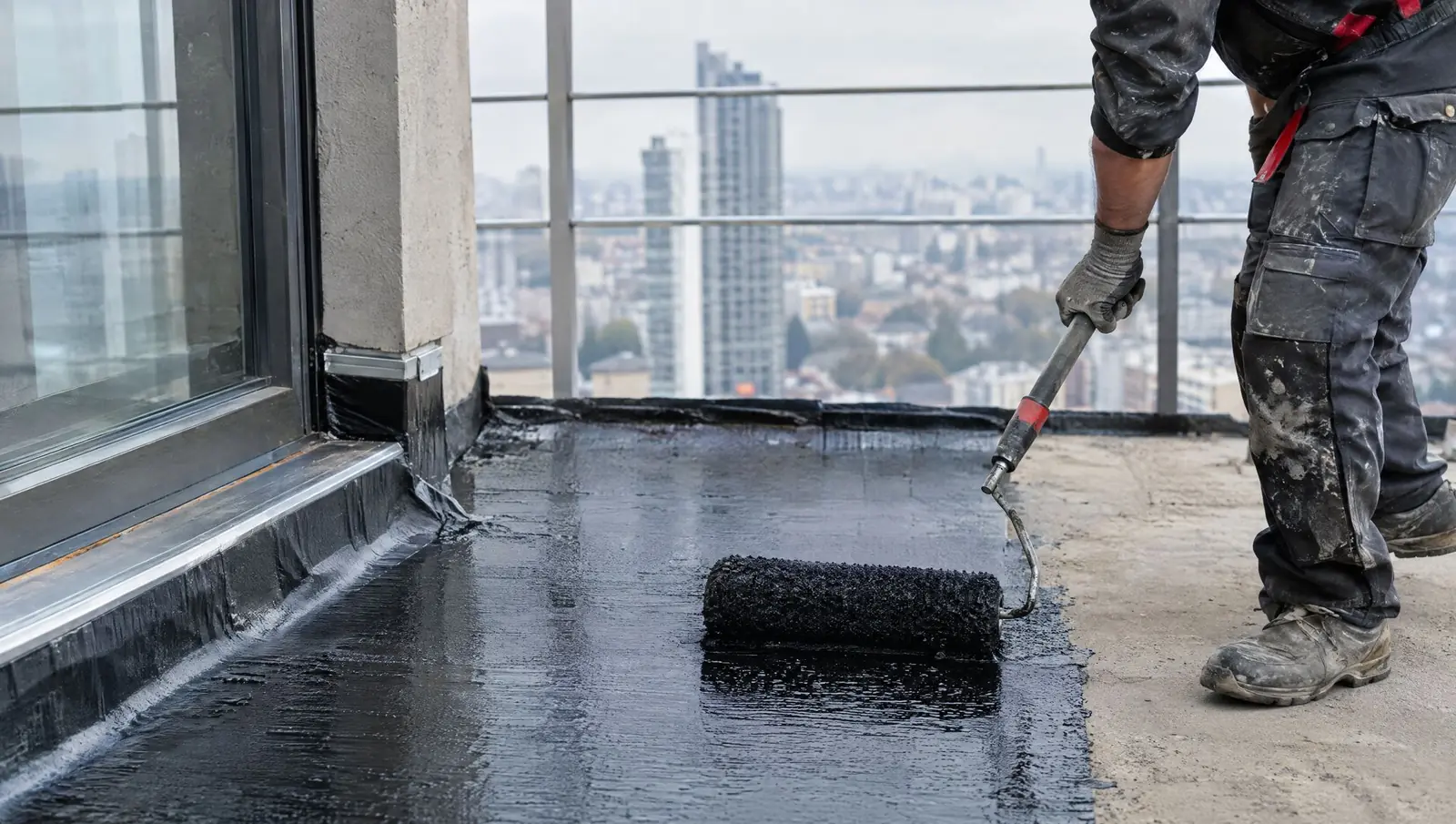
Balcony waterproofing systems fall into four families: liquid-applied membranes, sheet membranes, traffic coatings and cementitious systems. No single one is right for every balcony. The choice depends on the slab condition, how much the slab moves, the foot traffic, the edge and drain details, and what the engineer specifies. This guide compares the four in plain language so a board or manager can read a specification and ask better questions.
Key takeaways
- There are four common system families: liquid-applied membranes, sheet membranes, traffic coatings and cementitious systems. They differ in how they are installed, how they handle movement and how they are maintained.
- The membrane is only part of the system. Slab repairs, slope, edge details, door thresholds and drains decide whether water actually leaves the balcony.
- Surface preparation is a step that often decides whether a system bonds. Ask what prep the specification requires and how it will be checked.
- Ask the engineer and contractor for the product data sheets and the manufacturer's installation requirements, and do not accept lifespan claims that are not in writing.
Which balcony waterproofing system should a condo choose?
The honest answer is that the system should be chosen for the balcony, not the other way round. A concrete slab that has been surveyed, repaired and sloped properly can take several different balcony waterproofing systems. A slab that is cracked, moving or draining badly will fail under any of them until those problems are corrected first.
For a condominium corporation, the useful questions are what each family of systems does well, where it struggles, and what it asks of the slab beneath it. The table below compares the four families in general terms. It is a starting point for a conversation with your engineer, not a substitute for the specification.
| System family | Where it tends to fit | Surface preparation | Movement | Maintenance |
|---|---|---|---|---|
| Liquid-applied membrane | Irregular shapes, many penetrations, curved edges and railing posts, because the product flows around details | Clean, sound, dry substrate. Cracks and spalls repaired first. Primer is usually required | Depends on the product. Some are flexible, others are not. Check the data sheet for crack-bridging claims | Inspect for punctures, blisters and edge lifting. Repair damaged areas as the manufacturer directs |
| Sheet membrane | Larger, regular slabs where a factory-made sheet gives a consistent thickness. Often used where a protection layer or topping goes over it | Smooth, clean, dry substrate. Details at drains, walls and penetrations need careful finishing | Sheets are generally made to stretch, but seams and terminations are where movement shows up | Seams and terminations are the places to check. A topping layer can hide problems, so plan inspection points |
| Traffic coating | Surfaces that need to be walked on directly and where the coating is the visible wearing surface | Very sensitive to substrate condition and moisture. Repair, profile and prime as specified | Varies with the coating chemistry. Hard coatings crack with the slab if it moves | The wearing surface sees sun, snow and foot traffic. Expect periodic inspection and recoating of worn areas |
| Cementitious system | Rigid, stable substrates, and situations where a cement-based product suits the substrate or moisture conditions | Surface profile and dampening are specified closely. Needs a sound substrate | Generally less tolerant of movement than flexible membranes, unless a modified, flexible product is used | Check for cracking and efflorescence. Cracks in the substrate can reflect through |
These are general tendencies. Individual products within each family can behave differently, and manufacturers publish the details. If a table like this one and a data sheet disagree, the data sheet wins.
What is a liquid-applied membrane?
A liquid-applied membrane is a coating that is rolled, troweled or sprayed onto the prepared slab and cures into a continuous layer. Because it is applied wet, it can be worked around railing posts, door thresholds, wall junctions and drains without the cuts and overlaps that a sheet needs. That is its main advantage on balconies, which have many awkward details in a small area.
The trade-offs are about control. The thickness of a liquid system depends on how it is applied, so the specification normally sets a required thickness and the contractor checks it as the work proceeds. Cure time and weather limits matter as well, which is why our guide to balcony restoration in winter explains that membranes generally need mild, dry conditions. Some products are designed to be left exposed, while others need a protective topping or a separate wearing layer. The engineer's specification should say which one is intended.
What is a sheet membrane?
A sheet membrane arrives as a roll or panel made in a factory. It is bonded or adhered to the slab, and the seams and edges are sealed. Because the sheet is manufactured, its thickness is consistent across the roll, and that is its main strength on larger and more regular slabs.
The weak points are the places where sheets stop or meet something. Seams, laps, terminations at walls, and the transition around drains and posts all need careful detailing and inspection. A sheet system is often covered with a protection layer, drainage layer or topping. That is good for protecting the membrane, but it also hides it, so boards should ask the engineer where inspections will happen before the cover goes on. This matters because a leak under a topping can be hard to trace once the work is finished.
What is a traffic coating?
A traffic coating is a waterproofing and wearing surface in one. It is the visible finish that people walk on, and it is often applied in layers with an aggregate or texture added for traction. On a balcony, it appeals because the finished surface is clean and the whole system can be seen and inspected.
It also asks a lot of the substrate. A coating that bonds directly to the slab depends on the slab being sound, clean and dry, and on a primer that suits the concrete. Hard coatings can crack if the slab beneath them moves, so slab repairs and crack treatment come first. Because the surface is exposed to sun, snow, de-icing products and foot traffic, it will need periodic inspection and recoating of worn areas. Ask how wear will be handled over the life of the balcony, and which areas the manufacturer says to inspect. If rock salt is used on the balcony, ask the manufacturer about chemical compatibility. Our guide to spalling and rust stains on balconies explains how chlorides damage the steel inside the slab.
What is a cementitious system?
A cementitious system is a cement-based waterproofing product, sometimes modified with polymers, mixed on site and applied in coats. It bonds well to concrete and can be applied to damp surfaces in some conditions, which suits certain below-grade and enclosed applications.
On an exposed balcony it is less common, because cement-based layers are generally less tolerant of slab movement than flexible membranes. A rigid layer over a cracking slab can crack as well, and the cracks can reflect through. Polymer-modified products are more flexible, but they should be evaluated against the data sheet and the engineer's design. If a cementitious system is proposed, ask why it was chosen for this slab and what happens at the cracks.
Why does surface preparation matter so much?
Every system in the table above depends on a sound, clean substrate. A membrane or coating does not repair concrete. It sits on top of it. If the slab has delaminated areas, active corrosion, oil, laitance or moisture, the system may not bond, and it may fail early at those spots.
- Concrete repair first. Loose, spalled or delaminated concrete is removed, and exposed reinforcing steel is treated, before any waterproofing goes on. Our balcony restoration service covers both the repair and the waterproofing steps in one program.
- Cleaning and profile. Dirt, old coatings and laitance are removed. The specification often sets a surface profile so the product has something to grip.
- Moisture and temperature checks. The substrate must be dry enough and within the product's temperature limits. The engineer or contractor should record the checks.
- Primers and bond tests. Many systems need a primer. Some specifications call for a small test area or a pull-off test to confirm bond before the full balcony is done.
How do edge and drain details affect waterproofing?
Balcony leaks rarely start in the middle of a flat membrane. They start at the edges. The places to examine on any system are the door threshold, the wall junction, the slab edge, the railing post bases, the drain and any penetration through the slab.
- Door thresholds. Water that gets under a balcony door can enter the unit or the wall. The membrane has to turn up at the threshold and be tied into the door and wall assembly.
- Slab edges and drip details. The membrane should finish at the slab edge with a detail that sheds water away from the face of the slab, not back onto it.
- Railing posts. Each post is a hole in the waterproofing. Posts need a detail that seals around them. Our guide to railing replacement explains how anchorage and waterproofing interact.
- Drains and scuppers. The membrane must be properly tied into the drain so water does not run beneath it. Drains also need to be accessible for cleaning.
Why does drainage matter as much as the membrane?
Waterproofing keeps water out of the slab, but it works best when water has somewhere to go. A balcony that slopes toward the building or has low spots holds standing water against the membrane, the edges and the door. That water freezes in winter and expands, which loads every seam and edge. Our guide to freeze-thaw damage explains how that cycle degrades exterior concrete over time.
A good specification addresses slope as well as the membrane. Where the existing slab does not slope properly, the engineer may call for a sloped topping, a repaired surface or a drain change. A waterproofing system laid over a flat or reverse-sloped slab can look perfect on day one and still hold water for years. Ask the engineer how drainage was checked, and ask the contractor how ponding will be tested for before the work is signed off.
What should boards ask a contractor?
The following questions help a board or manager compare bids that propose different systems. They also work as a checklist when reviewing the engineer's specification.
Which system does the specification call for, and why?
Ask the engineer or contractor to explain the choice in terms of this slab, not in general terms.What surface preparation is required, and how is it checked?
Look for written steps for repair, cleaning, profile, moisture and primer, plus a record of the checks.How are the edges, drains, thresholds and posts detailed?
Ask to see the details on the drawings or in the product manufacturer's instructions.What are the weather limits for installation?
The product data sheet sets minimum and maximum temperatures and moisture limits. Ask how the contractor will monitor them.What inspections will the engineer do before each layer is covered?
Membranes should be inspected before toppings or finishes hide them.What warranty is offered, and what does it cover?
Ask for the warranty in writing. Read what it excludes, whether it depends on maintenance, and who is responsible for it.What maintenance does the system need?
Ask how often to inspect, what to look for, and how repairs are made.
Our guide to hiring a condo restoration contractor covers WSIB clearance, insurance, references and bid comparison. Our guide to balcony restoration vs replacement explains when the slab itself, not the membrane, is the issue.
What should you know about warranties and lifespan claims?
Product brochures and sales conversations sometimes mention long service lives. Treat those claims carefully. How long a waterproofing system lasts depends on the product, the substrate, the drainage, the installation quality, the exposure and the maintenance, and a number that is not in writing is not a commitment. Ask for the warranty terms and the manufacturer's data sheet, and read the exclusions. A warranty that depends on annual inspection or on using certain maintenance products is only as good as the board's ability to follow those conditions.
How CondoWorks can help
CondoWorks restores and waterproofs balconies on condominium buildings across Toronto and the GTA. We can walk the balconies with your property manager, review an engineer's specification, explain how each proposed system works, and quote a program that covers slab repairs, waterproofing, drains and railings under one schedule. Where structural or engineering input is needed we work with the board's engineer.
This page is general information. System selection, thicknesses, temperature limits and warranties depend on the building, the product and the engineer's specification, so use the project documents and manufacturer data sheets for decisions about your balconies.
Balcony waterproofing systems: common questions
Sources and further reading
- Ontario Regulation 213/91: Construction Projects (Ontario e-Laws)
- Ontario Regulation 332/12: Building Code (Ontario e-Laws)
- City of Toronto: Building Permits
- Canadian Condominium Institute: Maintenance and Repairs
- Condominium Act, 1998 (Ontario e-Laws)