Last updated
Balcony restoration in Toronto is the repair of deteriorated concrete, corroded reinforcing steel, waterproofing and guards on condominium and apartment balconies, often combined with a modern upgrade. CondoWorks restores balconies floor by floor so older buildings look current and last longer.
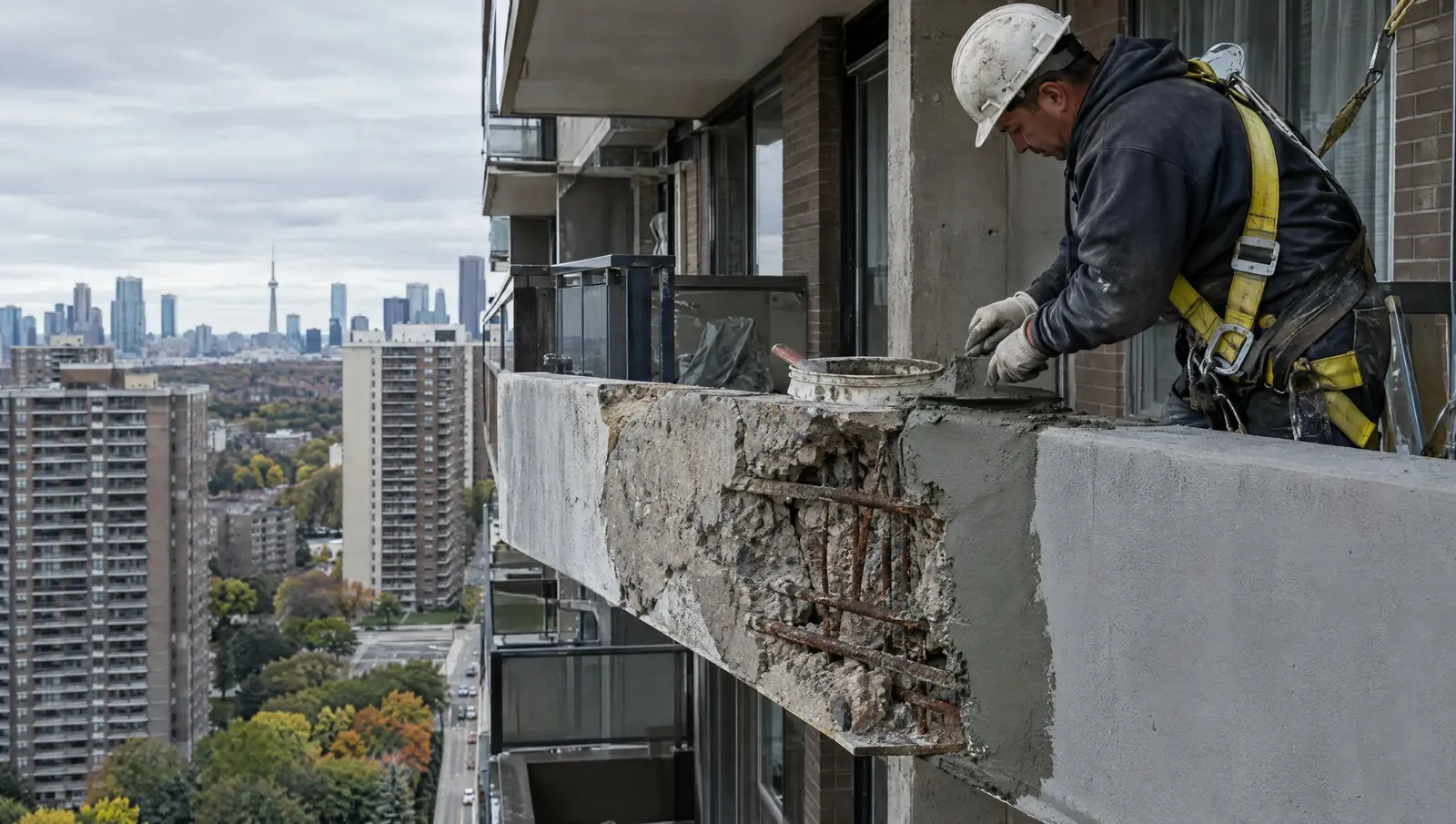
Many Toronto apartment and condo buildings carry balconies from the 1960s to the 1990s: exposed concrete slabs, cracked edges, rusting steel guards and coatings that stopped working years ago. Freeze-thaw cycles, road salt tracked outside and decades of water ingress corrode embedded reinforcing steel, and the damage shows up as spalling concrete, rust stains and loose railings.
A cosmetic coat does not fix that. A proper restoration removes unsound concrete, treats or replaces corroded reinforcement, rebuilds the slab edge, installs a membrane or traffic coating to shed water, and replaces outdated guards with a modern system. The balcony then lasts longer and the building looks current.
We offer the complete sequence for corporations and individual owners: engineering coordination, repair, waterproofing, new railings, and finish selection, delivered floor by floor so residents keep balcony access for as much of the program as possible.
What does balcony restoration in Toronto include?
- Condition survey and sounding of slabs, edges and soffits
- Concrete removal and patching, rebar treatment or replacement
- Slab-edge rebuilding and crack repair
- Waterproofing membrane or traffic coating with drainage details
- Railing and guard replacement with modern glass or aluminum systems
- Soffit and underside repair, new finishes and sealants
Modern upgrade options
Glass guards
Tempered glass panels in aluminum frames for open sightlines and a modern profile.
Aluminum picket systems
Powder-coated pickets in black, charcoal or custom colours, low maintenance and engineered to code.
Coated slab finishes
Traffic-grade coatings in slip-resistant finishes that hide hairline marks and shed water.
How balcony restoration works, step by step
Survey and engineering
Sounding survey and, where required, a structural engineer's repair design.Notice and access
Schedule by floor and elevation, resident notices and balcony contents removal.Concrete repair
Remove delaminated concrete, treat steel, rebuild edges and cracks.Waterproof and finish
Apply membrane or coating with correct slope and drainage.Install guards and inspect
Install new railings, test fasteners, final review with the engineer.
Why older balconies fail
Most balconies on Toronto buildings from the 1960s through the 1990s are cantilevered or supported concrete slabs reinforced with steel bars. When the concrete is new, it protects the steel with a high-alkaline cover that stops corrosion. Over decades, that protection breaks down. Carbon dioxide and de-icing salts penetrate the concrete, hairline cracks let water reach the bars, and the steel begins to rust. Rust takes up more volume than steel, so it pushes the concrete outward until pieces break off. This is called spalling, and it usually begins at the slab edge and the underside, where moisture collects.
Freeze-thaw cycles speed the process. Water inside the concrete freezes, expands and widens cracks each winter. Add coatings that have peeled or never existed, failed sealants at the door threshold and drains that do not shed water, and the slab spends most of the year wet. The result is the familiar picture: rust stains on the soffit, bare bars at the edge, flaking surface and a guard that has begun to move in its anchorage.
What a restoration assessment looks for
An assessment of a balcony or a whole building's balconies is a structured survey, usually led by an engineer for a corporation program. It typically includes:
- Sounding. Tapping the slab to find hollow-sounding delaminated areas that are not yet visible.
- Visual survey. Cracks, rust staining, exposed steel, efflorescence and ponding.
- Edge and soffit review. The slab edge and underside, where deterioration often starts.
- Guard and anchorage check. Looseness, corrosion at posts and the condition of anchors.
- Drainage and slope. Whether water flows away from the building and off the slab.
- Door thresholds and sealants. Common entry points for water into the unit and the wall.
The output is a repair schedule that classifies each balcony, such as minor repair, major repair or full restoration, so the corporation can budget and phase the work. We use that schedule to price and plan the program.
Concrete repair done properly
Durable repair is more than patching. The steps matter, and skipping them is why quick fixes fail within a few seasons:
- Remove all unsound and delaminated concrete back to solid material, usually with light hydraulic or hand tools to avoid damaging sound areas.
- Expose the corroded steel, clean it to bright metal and, where the loss of section is significant, supplement or replace it as directed by the engineer.
- Apply a protective coating or corrosion inhibitor to the steel.
- Place repair mortar or concrete rated for structural repair, bonded to the substrate and cured properly.
- Rebuild the slab edge to the correct profile and slope, with a drip detail so water falls free of the face.
- Inject or route and seal cracks that would otherwise let water back in.
The repair is inspected before it is covered, because the work behind the finish is what determines the life of the balcony.
Modernizing the look of an old building
A restoration is also a chance to change how the building looks. Balconies are visible from every direction and define the building's character. Replacing painted steel rails with framed glass or powder-coated aluminum guards, switching a stained grey slab to a consistent coated finish, and refreshing soffits and sealants can make a thirty-year-old building look current. The guard design and colour are usually the biggest visual decision, and it needs board approval and consistency across the building.
We help boards evaluate options with samples and mock-ups where possible. Glass offers open views, aluminum offers economy, and a combination can balance appearance and budget. We also advise on practical matters such as wind loads on tall buildings, cleaning, privacy and the effect of new guards on the building's lighting and energy performance.
Program planning: seasons, access and residents
Balcony programs usually run across several months and affect every resident whose balcony is being worked on. Planning decisions that matter:
- Season. Concrete repair and waterproofing perform best in warm, dry weather, so programs are scheduled from spring to autumn.
- Access. Work from swing stages, mast climbers or from the balcony itself, depending on building height and layout.
- Resident notice. Residents must remove furniture and plants and expect noise, dust and limited access for days or weeks per balcony.
- Phasing. Working by elevation or by stack keeps the program organized and limits how many residents are affected at once.
- Safety. Barriers below work areas, protected walkways and secured doors keep the public and residents safe.
We prepare resident notices, schedules and instructions that the property manager can distribute, and we confirm access with residents ahead of each phase.
Cost drivers and how programs are budgeted
A balcony program is usually priced per balcony, with a unit price for each type of repair and a set of allowances for unforeseen conditions. The major cost drivers are the quantity of concrete repair, the number and type of guards, the waterproofing system, access method, the number of balconies, and the program's phasing. Because the extent of deterioration is not fully visible until concrete is removed, contracts often use unit prices for repair quantities, so the corporation pays for what is actually found. We recommend including a contingency in the budget and reviewing quantities with the engineer as work proceeds.
Questions owners and boards should ask
To avoid disappointment, ask:
- Was an engineer involved in the repair design? Structural repairs benefit from professional design.
- How much concrete was repaired, and how was steel treated? Quantities and methods should be documented.
- What waterproofing and railing systems were selected? Match them to exposure and budget.
- How long will each balcony be out of service? Residents need dates.
- What is the warranty, and who maintains what? Clarify responsibilities.
- Can we see samples or a mock-up? Approve appearance before installation.
Balcony restoration across the Greater Toronto Area
We take balcony restoration projects in Scarborough, Markham, Oakville and across the rest of Toronto and the Greater Toronto Area. Related services you may need alongside this one: balcony waterproofing, balcony railing replacement, condo exterior restoration, parking garage restoration and condo restoration.
Ready to start? Request a free assessment, learn about CondoWorks or check our service areas.