Last updated
Water damage restoration in Toronto is the process of finding the source of a leak or flood, extracting water, drying the structure to a verified standard and rebuilding finishes. CondoWorks restores the affected condo suite and the units above and below it.
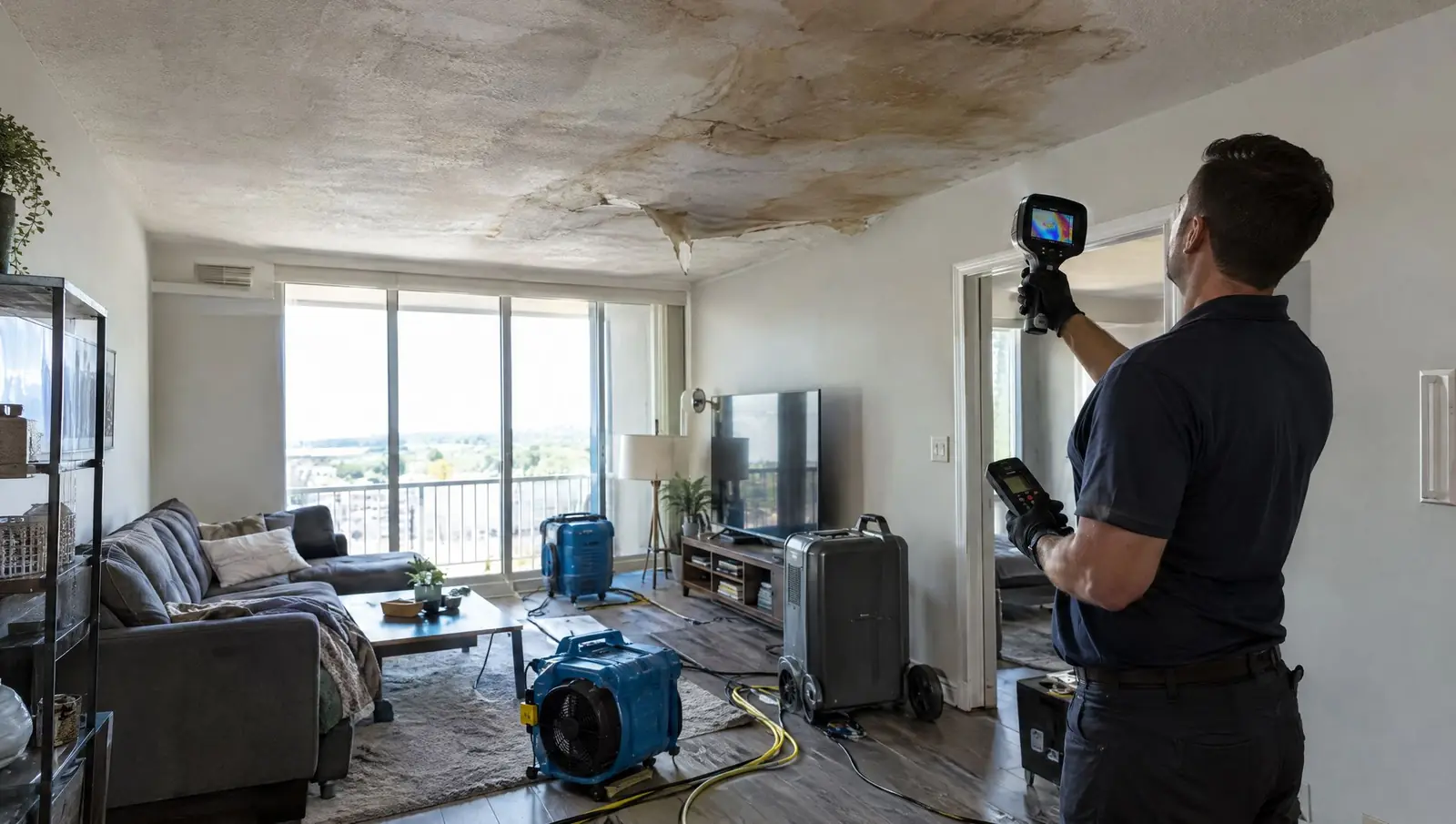
Water damage in a condo is almost never contained. A single failed toilet supply line or washing machine hose can soak flooring, drywall and insulation in the unit, then travel through the slab into the ceiling of the apartment below. Each unit affected is a separate scope, with a separate owner and often a separate insurer.
Restoration starts with finding where the water came from and where it went. We use moisture meters, thermal imaging and, where needed, borescopes to map wet materials. Then we extract standing water, remove materials that cannot be dried, and place air movers and dehumidifiers to dry the structure to target moisture levels.
Documented drying is what keeps mold from developing later. We record readings daily until the structure is dry, then rebuild flooring, drywall, baseboards, cabinets and paint to match the existing finishes.
What does water damage restoration in Toronto include?
- Source identification and moisture mapping
- Water extraction and removal of non-salvageable materials
- Structural drying with dehumidifiers and air movers, with daily readings
- Antimicrobial treatment where indicated
- Drywall, insulation, flooring and finish rebuilding
- Coordination with the unit above and below
Water categories we handle
Clean water
Supply line breaks, appliance leaks and rain intrusion. Fastest to dry when treated early.
Grey water
Dishwasher or washing machine discharge, which needs sanitizing and careful material decisions.
Black water
Sewage and floodwater. Treated as a biohazard and handled by our sewage cleanup process.
How water damage restoration works, step by step
Stop and assess
Shut off the source and map wet areas, including neighbouring units.Extract
Remove standing water and unsalvageable materials.Dry
Set equipment and monitor moisture daily.Verify
Confirm dry standards with readings and photos.Rebuild
Restore finishes and hand over documentation.
The science of drying a condo structure
Professional drying relies on controlling temperature, airflow and humidity so water leaves materials as vapour and is removed from the air. Air movers push dry air across wet surfaces, speeding evaporation. Dehumidifiers remove the resulting moisture from the air. Specialized equipment can also dry cavities behind baseboards and under floors by forcing air through small openings, which avoids tearing out finished materials when they can be saved.
Our technicians place equipment according to measured conditions, not a formula. They record starting readings in each affected material, set targets based on the dry reference of unaffected materials in the same unit, and monitor daily. Equipment is moved or removed as materials reach target, and the job ends when readings confirm the structure is dry. This documented standard is what protects against mold later and satisfies insurers.
What can be saved and what cannot
The decision to dry or discard a material depends on what it is made of, what kind of water wet it, and how long it was wet. Clean-water losses allow more materials to be saved. Typical guidance:
- Hardwood and engineered flooring. Often dried in place with specialized mats if addressed early, though cupping and finish damage can still occur.
- Drywall. Wet drywall that is saturated, sagging or stained is usually replaced. Lightly affected walls can sometimes be dried by opening the cavity base.
- Insulation. Wet batt or loose insulation is generally removed because it holds moisture.
- Carpet and underlay. Carpet can be extracted and dried after clean water; underlay is often replaced.
- Cabinets and millwork. Solid wood may survive; particleboard swells and typically cannot.
- Concrete and tile. Generally dry well, but any subfloor materials and adhesive layers need checking.
We explain what we recommend and why before we remove anything, and photograph removed materials for the insurer.
Water that reaches other units
The most expensive part of a condo water loss can be the damage to other units. Water that leaves the source unit may drip from ceilings, run down walls, collect inside light fixtures and soak insulation. We recommend that any ceiling stain or drip be reported immediately, and we assess below the source unit and often beside it.
Our process for multi-unit losses is to coordinate access through the property manager, assess each unit with the same instruments and document each separately. Each unit has its own drying plan because materials and exposure differ. We keep records by unit number so every owner and insurer receives only what applies to their suite. When the source is a common-element line, we provide the evidence the corporation needs for its own insurance and repair.
Preventing the next leak
Most condo water losses come from a short list of causes, and many are preventable:
- Supply hoses. Rubber hoses on washing machines, dishwashers and toilets fail with age. Braided stainless hoses last longer and should be replaced periodically.
- Water heaters. Tanks corrode and leak. Drain pans with a connected drain or a leak sensor reduce the risk.
- Fixtures and sealant. Tub, shower and sink caulking should be inspected annually.
- Absence. Shutting off the main water valve to the unit when away for long periods prevents unattended leaks.
- Leak sensors. Inexpensive water sensors near appliances alert you to a leak early.
We are happy to advise owners on practical prevention steps after a loss, because a second loss is far more disruptive than the first.
Timeline and cost factors
Water damage restoration is billed according to scope: the extent and category of water, the materials affected, the equipment and days of drying required, and the reconstruction. A small clean-water loss in one room may take a few days of drying and a short rebuild. A multi-unit loss or a sewage contamination takes considerably longer. We estimate after assessment, explain the assumptions and update the estimate if conditions change. Insurance coverage will determine how much is paid by whom, and we provide the documentation for your claim.
Understanding the three categories and four classes of water damage
Restoration standards classify water losses to guide decisions. Category 1 is clean water from a sanitary source, such as a broken supply line. Category 2, sometimes called grey water, has significant contamination, such as washing machine discharge. Category 3 is grossly contaminated and may contain pathogens, such as sewage or flood water. Water can deteriorate from one category to another over time as it sits and as it contacts building materials.
Classes describe how much water has been absorbed and the rate at which it will evaporate. Class 1 involves minimal absorption, Class 2 involves a larger area with water wicked up walls, Class 3 involves water coming from overhead and saturating ceilings, walls and carpet, and Class 4 involves deep saturation of low-permeance materials like hardwood, plaster and concrete, which require specialized drying. Category and class together determine the equipment and time needed, and the risk to health.
We apply these classifications at the start of each job and record them in the report, which helps insurers understand the scope.
Questions to ask about water damage restoration
Choosing a contractor under pressure is easier with a short list:
- What will you measure, and how often? Daily moisture readings are the basis of proper drying.
- What is your dry standard? The contractor should compare readings with unaffected materials in the same unit.
- Do you inspect the units above and below? Water rarely stays in one suite.
- What will you remove, and why? Each removal should have a reason and a photograph.
- When can equipment be removed? Only after readings confirm dryness.
- Do you rebuild as well? A single point of responsibility simplifies claims.
The short version
The short version: act within hours, find and stop the source, extract and dry with measured readings, check the units above and below, and rebuild only after the structure is verified dry. Keep photographs and receipts for your insurer. CondoWorks handles each stage as one team, which means one schedule, one record of what happened and one party accountable for the result in your suite and the surrounding units.
Water damage restoration across the Greater Toronto Area
We take water damage restoration projects in Vaughan, Oakville, North York and across the rest of Toronto and the Greater Toronto Area. Related services you may need alongside this one: emergency condo restoration, condo mold remediation, condo leak detection, condo insurance claims support and sewage backup cleanup.
Ready to start? Request a free assessment, learn about CondoWorks or check our service areas.