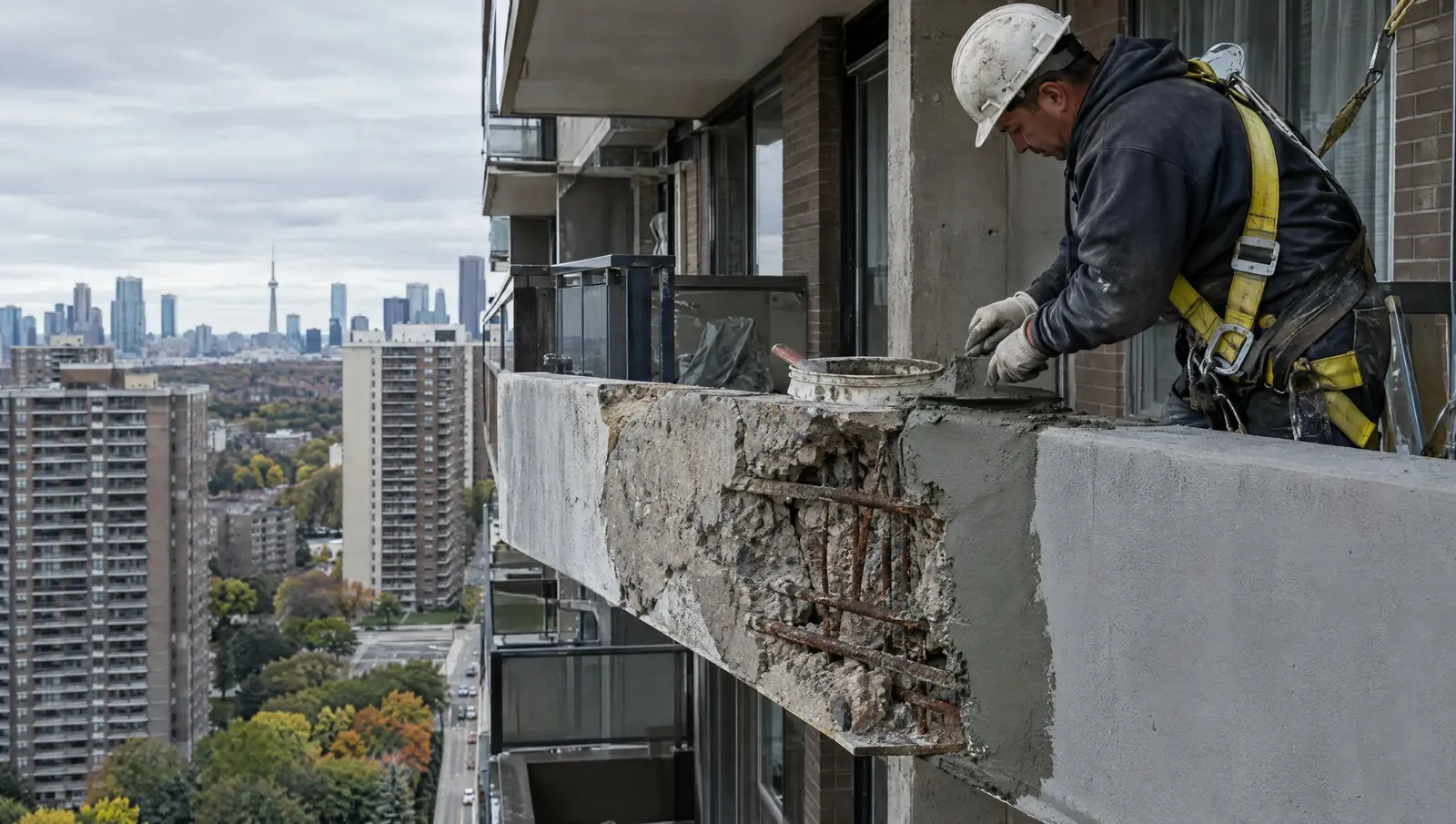
Balcony restoration repairs the existing slab, waterproofs it and renews the guards, while replacement removes and rebuilds the slab. An engineer's condition survey decides which one a building needs. Restoration is usually the first choice when the structure is sound, and replacement is justified when it is not.
Key takeaways
- The deciding factor is the structural condition of the slab, edge and reinforcing steel, not the age of the building or how bad the surface looks.
- An independent engineer's condition survey, with sounding and testing, should come before any contractor quotes.
- Restoration normally combines concrete repair, a new waterproofing system, drainage and guard work. Replacement is reserved for slabs that cannot be repaired economically.
- Boards should compare options by life-cycle cost and risk, and check how the Condominium Act treats the work before they vote.
How do engineers decide between balcony restoration and replacement?
The decision rests on evidence gathered by a licensed engineer, not on appearance. Cracked paint and rust stains look alarming, but they can sit on top of a slab that is structurally fine. A slab with a smooth surface can hide serious damage underneath.
A typical condition survey for a condominium balcony program includes:
- Visual review of every balcony: cracks, spalls, rust staining, efflorescence, ponding water and the state of the guards and their anchors.
- Sounding of the slab surface, by hammer or chain drag, to find delaminated concrete that looks intact but has separated from the reinforcing steel.
- Testing on selected balconies, such as cores, chloride content and cover depth, to understand how far salt and corrosion have progressed.
- Opening up a sample of areas to see how much steel has actually been lost to corrosion.
The engineer then compares the findings to what the slab must carry and how long the owners want the repair to last. There is no universal percentage that flips a balcony from repair to replacement. It is a judgment about structural capacity, the extent of deterioration, and whether repairing is still cheaper and safer over the long run than rebuilding.
What does balcony restoration include?
Balcony restoration keeps the structure and renews everything that protects it. The usual scope is:
Concrete repair
Remove loose and delaminated concrete, treat or replace corroded steel, and rebuild the section with repair mortar suited to the exposure.Waterproofing
Install a traffic-bearing membrane or coating system, with proper details at edges, drains and door thresholds. See balcony waterproofing for how these systems differ.Drainage and slope
Correct ponding so water leaves the slab instead of sitting on it through freeze-thaw cycles.Guards and railings
Repair or replace guards and their anchorage. Corroded or loose guards are a safety issue and are often done in the same program. See balcony railing replacement.
Restoration is usually the lowest-disruption option because the slab stays in place and each balcony can often be finished in days to a few weeks, depending on scope and weather.
When is balcony replacement justified?
Replacement removes the slab and builds a new one. It is normally considered when:
- Corrosion has reduced the reinforcing steel enough that repair would mean replacing most of the slab anyway.
- Deterioration is widespread, so repair would be a patchwork that fails again soon.
- The slab is a cantilever that cannot be strengthened or reliably waterproofed at its connection to the building.
- The guard anchorage cannot be restored because the concrete around it has failed.
- A site-wide redesign is planned, such as a change to the balcony size, guard type or drainage, and it is cheaper to rebuild than to retrofit.
Replacement costs more, takes longer, and may need building permits and engineered drawings. It is worth the premium only when the evidence shows repair will not deliver a dependable result.
Restoration versus replacement at a glance
| Question | Restoration | Replacement |
|---|---|---|
| What it needs from the slab | A structure that can still carry load after repair | A slab that cannot be repaired economically |
| Typical disruption | Shorter, balcony by balcony | Longer, with demolition and rebuilding |
| Typical paperwork | Engineer's specification and review | Engineered drawings and likely permits |
| Cost profile | Lower up front, depends on repair quantities | Higher up front, longer expected life |
| Main risk | Hidden damage found once the surface is opened | Cost, schedule and owner disruption |
How should a board compare the options?
Ask the engineer to price each option over the same period, not only today. A cheaper repair that must be redone in a few years can cost more than a replacement that lasts decades. Useful questions include:
- What is the expected service life of each option, and what maintenance does it need?
- Which balconies are in the worst shape, and can the work be phased by risk?
- What allowance has been made for hidden damage found during the work?
- How does the proposed cost fit the reserve fund? Our guide to reading a reserve fund study explains how balcony programs show up in the plan.
Boards should also check whether safety is at stake. If the engineer flags a guard or slab as an immediate hazard, that balcony may need to be closed or shored before the wider program is decided.
What does the Condominium Act say about approval?
In Ontario, a corporation is responsible for repairing the common elements, and balcony slabs are usually common elements. Repairing or replacing like for like is generally treated as maintenance. Changes that substantially alter the common elements, such as a different balcony size or a new guard design, can trigger the owner-approval rules in section 97 of the Condominium Act, which commonly require a two-thirds vote of owners for substantial changes. Whether a particular project counts as a repair or a change depends on the facts and the corporation's documents, so confirm with the corporation's lawyer before the board commits.
What is it like for residents?
Residents lose use of the balcony during the work, need to clear furniture and plants beforehand, and live with noise from chipping and drilling. Good programs reduce friction with a published schedule, notice before each balcony is closed, protected entrances and a named contact. Exterior work also depends on weather: membranes need dry, mild conditions, so winter limits what can be installed. For the wider picture, see our guide to condo exterior restoration, since balcony work is often combined with facade and parking garage repairs to save on access equipment.
Choosing who does the work
The engineer who writes the specification should be independent of the contractor who builds it. Ask bidders to price the same scope, with unit prices for extra concrete repair so hidden damage does not turn into a dispute. CondoWorks builds balcony programs for condominiums across the GTA, including downtown Toronto and Mississauga. If you want a contractor's view of scope and sequencing, request a free assessment.
Balcony restoration vs replacement: common questions
Sources and further reading
- Condominium Act, 1998 (Ontario e-Laws)
- Canadian Condominium Institute: Maintenance and Repairs
- Toronto Condo News: changes to common elements