Last updated
Condo mold remediation in Toronto is the containment, removal and verification process used to clear mold from a suite while fixing the moisture source that caused it. CondoWorks works under negative air and checks adjoining units and wall cavities.
Mold in a condo is a moisture problem first. It appears after leaks, plumbing failures, condensation on cold exterior walls, window or balcony leaks, and wet materials that were not dried quickly. Scrubbing the visible patch without fixing the moisture source guarantees it will be back.
Remediation follows a sequence: find and correct the moisture source, contain the work area under negative air, remove affected porous materials such as drywall, insulation and baseboard, clean and HEPA-vacuum remaining surfaces, and dry the area. Post-remediation testing then confirms that the space is clean.
In a multi-unit building we also check adjoining units and wall cavities, because mold frequently spreads behind finished surfaces.
What does condo mold remediation in Toronto include?
- Visual inspection and moisture mapping
- Air and surface sampling where appropriate
- Containment with negative air and HEPA filtration
- Removal of contaminated porous materials
- Cleaning, HEPA vacuuming and antimicrobial treatment
- Post-remediation verification and rebuild
Where condo mold hides
Behind walls and under floors
After slow leaks or water events, wall cavities and subfloors stay damp.
Exterior wall corners
Cold surfaces and poor air circulation cause condensation and growth.
Bathrooms and kitchens
Inadequate ventilation and small leaks around fixtures.
How condo mold remediation works, step by step
Inspect and test
Find visible and hidden growth and the cause of moisture.Fix the source
Repair leaks or ventilation issues.Contain
Seal off the area and run negative air.Remove and clean
Take out affected materials and clean surfaces.Verify
Test, then rebuild finishes.
Why mold develops in high-rise units
Mold needs moisture, an organic food source such as drywall paper, wood or dust, and time. It does not need much of any of them. In condominiums, moisture comes from several directions: plumbing leaks inside walls, water from a neighbouring unit, leaking windows and balcony doors, condensation on cold exterior walls in winter, high humidity from inadequate ventilation, and water events that were not dried quickly or thoroughly.
Tight modern buildings can trap humid air, especially in bathrooms and kitchens with weak exhaust, and in units where the heating and cooling system is not run consistently. Cold corners, closets against exterior walls and behind furniture often show growth first. The fix is not just removing the mold: it is finding and correcting what is feeding it.
Assessment: finding hidden growth
Visible mold is often the smaller part of the problem. Our assessment includes:
- A visual inspection of walls, ceilings, windows, baseboards, closets and under-sink cabinets.
- Moisture mapping with meters and thermal imaging to detect damp materials behind finishes.
- Investigation of potential sources: plumbing, balcony doors, windows, ventilation and neighbouring units.
- Air and surface sampling where appropriate, with laboratory analysis, to confirm and characterize contamination.
- A written plan that defines affected areas, the containment method and verification criteria.
Testing is done to inform decisions, not to create alarm. We explain what the results mean and what they do not, since interpretations of mold sampling are subject to variation and professional judgment.
Containment, removal and cleaning
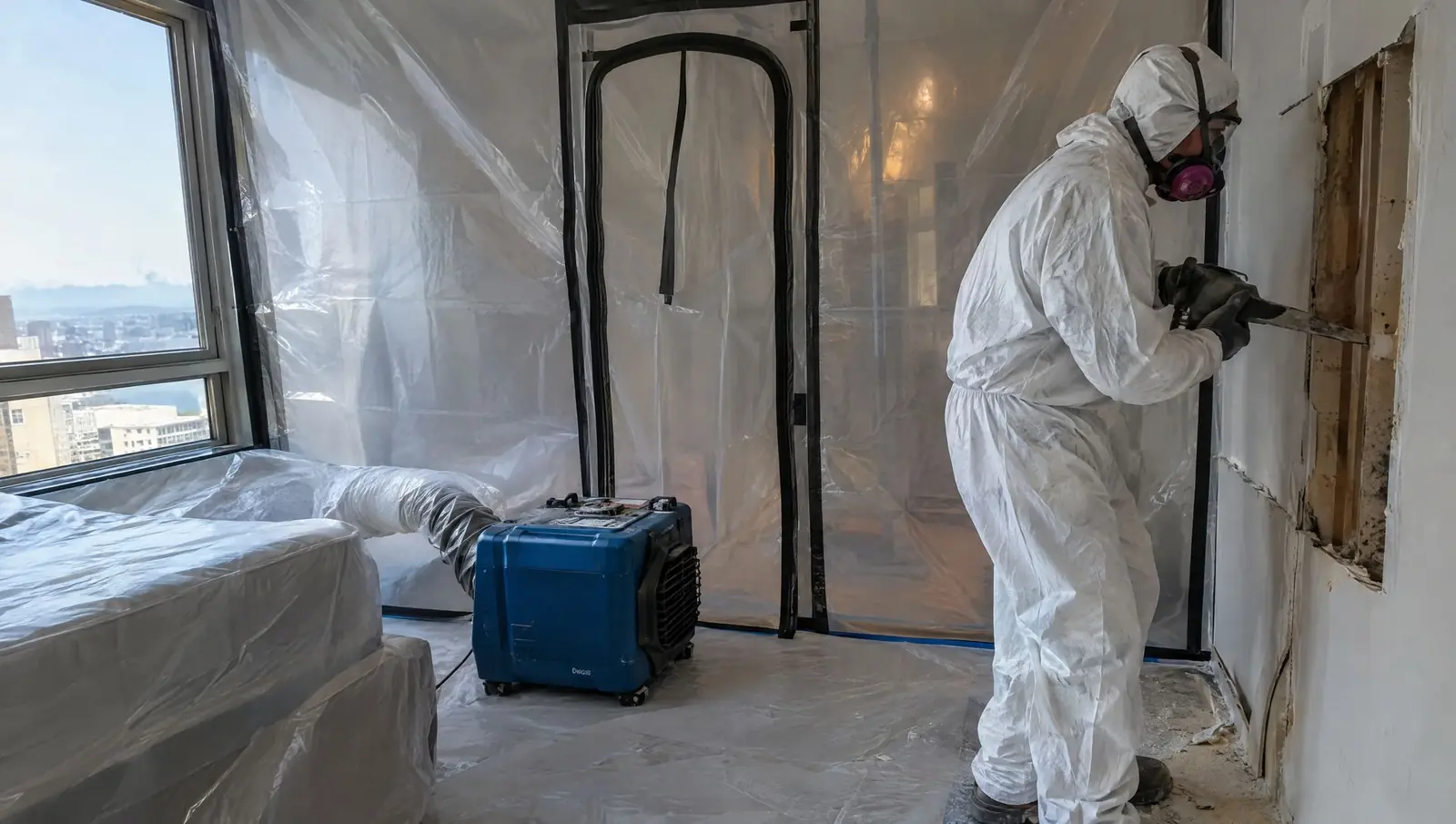
Containment prevents spores from spreading during removal. We seal the work area with plastic barriers, maintain negative air pressure with HEPA-filtered exhaust and protect adjacent areas. Workers wear respirators and protective clothing. Porous materials with mold growth, such as drywall, insulation and carpet, are removed, bagged and carried out in sealed containers. Structural materials such as studs are cleaned by HEPA vacuuming, wire brushing or sanding, and wiping, depending on the surface.
After removal, the area is dried and cleaned again, and surfaces are treated where appropriate. Only after drying and verification are walls closed and finishes reinstalled. Skipping drying or verification is why re-growth occurs.
Verification and preventing recurrence
Post-remediation verification confirms that the area is clean before it is rebuilt. This may include visual inspection, moisture readings and, where specified, air or surface sampling compared with the unaffected areas or outdoor air. When the results satisfy the criteria, the area is released for reconstruction.
To prevent a recurrence, we advise on humidity control (generally keeping indoor relative humidity at a moderate level), exhaust fan use, window and door sealing, furniture spacing from cold walls and prompt cleanup of spills. If the cause is in a common element, such as a leaking exterior wall or window, we document it for the corporation so it can be repaired. Without that fix, remediation inside the unit will be temporary.
Who is responsible for mold in a condo
Responsibility depends on the source and the declaration. Mold caused by a leaking common-element pipe, a façade leak or a balcony defect typically involves the corporation. Mold caused by an owner's appliance, plumbing or lack of ventilation generally involves the owner and their insurance. Many disputes arise because the source is unclear, which is why we focus on identifying it with evidence. We do not determine legal responsibility, but our records give owners, managers and insurers a factual basis for deciding.
Mold testing: what the results mean and what they do not
Testing can be useful, but it is often misunderstood. Air samples capture the spores in the air at one moment, and results vary with ventilation, activity and weather. Surface samples identify what is growing on a particular spot. Laboratories report types and counts, but there are no universal numeric limits for acceptable indoor mold levels in Canada. Interpretation depends on comparison: indoor against outdoor air, affected against unaffected rooms, before against after remediation.
For that reason, we use testing as part of a broader assessment and not as the only basis. Visual evidence, moisture readings and knowledge of the building usually tell us more than a single sample. When a client or insurer requires testing, we arrange it and explain the report, including its limits. Be wary of anyone who offers dramatic conclusions from a single test or who recommends remediation without finding the moisture source.
Health considerations and when to involve a physician
Exposure to mold can cause symptoms in some people, such as nasal congestion, cough, wheezing, eye and skin irritation, and worsening of asthma and allergies. People with weakened immune systems or chronic lung disease are at higher risk of more serious effects. The effects vary a great deal between individuals, and there is no way to say from a mold type alone what any person will experience.
If you or a family member has symptoms that seem related to a space, speak with a physician, and tell building management that you are concerned. During remediation, occupants should stay out of the work area and, depending on the scale, out of the unit. Ensuring the area is properly contained protects neighbours as well. We do not provide medical advice, but we can give physicians and insurers factual information about conditions and the work performed.
Rebuilding after remediation
When verification is complete, reconstruction begins. We install new insulation and drywall, use moisture-resistant products in wet areas, prime and paint, and reinstall baseboards, cabinets and flooring. Where the cause was an envelope or plumbing defect, the repair is completed before closing walls. We also advise on ongoing humidity control and recommend monitoring for a period. A compact moisture meter and a hygrometer are inexpensive tools that help owners notice problems early.
Questions to ask a mold remediation company
Mold work is easy to do badly, so ask:
- How will you find the moisture source? Without this, growth returns.
- What containment will you use? Barriers and negative air protect the rest of the building.
- What will you remove? Porous affected materials should be removed, not painted over.
- How will you verify the result? Inspection, readings and sometimes sampling.
- Do you rebuild? The same company can close walls after clearance.
- What do you advise to prevent recurrence? Humidity control and repairs to the source.
Condo mold remediation across the Greater Toronto Area
We take mold removal & testing projects in Oakville, Etobicoke, Mississauga and across the rest of Toronto and the Greater Toronto Area. Related services you may need alongside this one: water damage restoration, condo leak detection, condo odour removal and air filtration, asbestos testing and abatement and condo insurance claims support.
Ready to start? Request a free assessment, learn about CondoWorks or check our service areas.