
Last updated
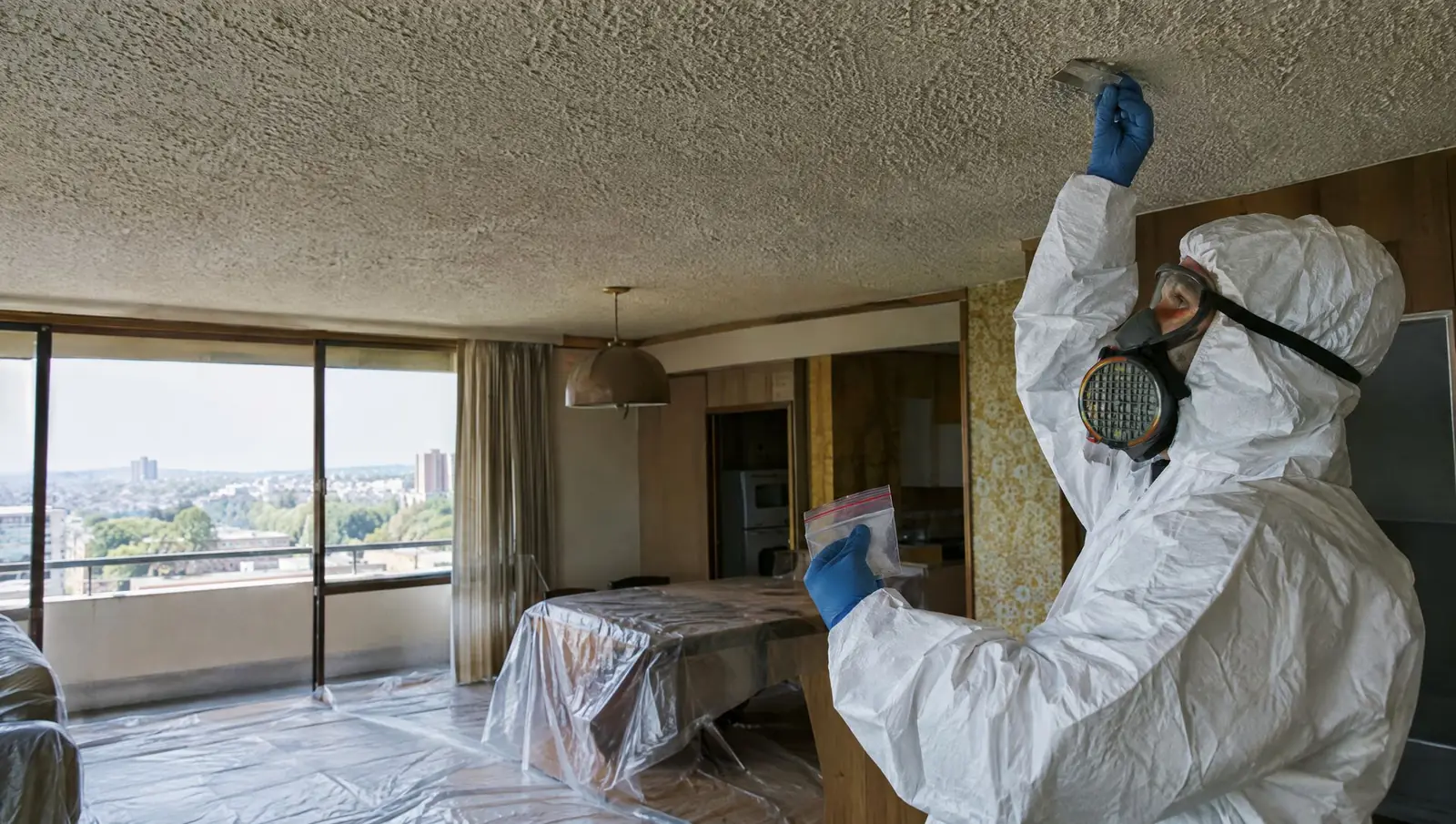
Asbestos testing and abatement in Toronto is the sampling of suspect materials in older condos and apartments and, where asbestos is found, controlled removal under Ontario's regulation. CondoWorks tests before demolition and plans containment, disposal and clearance.
Buildings constructed before the mid-1980s can contain asbestos in plaster, ceiling texture, vinyl floor tile and adhesive, pipe insulation, drywall joint compound and other materials. The material is only a hazard when disturbed, which is why testing matters before demolition, drilling or renovation after a loss.
Ontario regulates asbestos on construction projects under Ontario Regulation 278/05. Owners and contractors must identify asbestos-containing materials before work that could disturb them, and certain removals must follow set procedures for containment, worker protection and waste.
We sample suspect materials, send them to an accredited laboratory, and if asbestos is confirmed, plan abatement under the regulation, with sealed containment, HEPA filtration, controlled waste disposal and clearance testing.
What does asbestos testing abatement in Toronto include?
- Bulk sampling of suspect materials
- Laboratory analysis and written results
- Abatement planning to the applicable regulatory requirements
- Containment, negative air and HEPA filtration
- Controlled removal, bagging and disposal
- Clearance sampling and report
Materials commonly tested
Ceiling and wall finishes
Textured ceilings, plaster and joint compound in older buildings.
Flooring
Vinyl tile, sheet flooring and adhesive layers.
Pipe and duct insulation
Wraps and coatings on pipes and mechanical systems.
How asbestos testing abatement works, step by step
Review
Check building age and scope of work.Sample
Collect samples without spreading fibres.Analyze
Submit to an accredited laboratory.Abate if required
Contain, remove and dispose per regulation.Clear
Verify with clearance testing before rebuild.
Where asbestos is found in older Toronto condos and apartments
Asbestos was widely used in building materials in Canada until the 1980s because it resists fire, heat and chemicals. In older apartments and condominiums it can be present in products that look unremarkable: textured or stippled ceilings, plaster, drywall joint compound, vinyl floor tile and its black adhesive, sheet flooring backing, pipe and duct insulation, boiler and mechanical wrap, fireproofing sprayed on structural steel, cement panels and some roofing and exterior materials.
Intact asbestos-containing material is generally not an immediate health risk. The danger arises when fibres are released by cutting, sanding, drilling, demolition, water or fire damage that breaks materials down, or ageing that makes them friable. Because fibres are microscopic and cannot be identified by sight, the only reliable method of confirming is laboratory analysis of samples.
The regulatory framework in Ontario
In Ontario, asbestos on construction projects and in building repair operations is governed by Ontario Regulation 278/05 under the Occupational Health and Safety Act. In general terms, owners must determine whether asbestos-containing materials are present before work that may disturb them, and work is classified into types based on the amount of dust and the material involved. Higher-risk work requires more controls, such as enclosure, negative air, decontamination facilities, specific respiratory protection and worker training. Waste is handled and disposed of according to environmental and transport regulations.
Condominium corporations frequently require a designated substance survey or testing before approving renovations in older buildings. We follow the requirements applicable to the project and advise clients when a consultant's survey is needed. Regulations change, so confirm the current requirements with the Ministry of Labour or a qualified consultant for your project.
Sampling and laboratory analysis
A proper sampling plan identifies each distinct material in the work area and takes enough samples of each to be representative. Samples are taken by trained personnel using methods that avoid releasing fibres, such as wetting the material and sealing the sampled spot afterwards. Samples are sent to an accredited laboratory for analysis under standard methods, and results are issued in writing, usually within a few days, with rush options available.
Results guide the next steps. If no asbestos is found, work can proceed. If asbestos is found, the report identifies the material, location and amount, and we provide options: leave it undisturbed and encapsulate, remove only what the work will disturb, or remove it fully. The decision depends on the planned renovation, building policy and cost.
How abatement is carried out
Abatement is controlled removal. The sequence is consistent regardless of the material:
Preparation
Notices are given, the area is isolated and ventilation is shut down or sealed so fibres cannot travel.Containment
Polyethylene barriers, negative air machines with HEPA filters and a decontamination unit are installed.Removal
Materials are wetted and removed by trained workers wearing respirators and protective suits.Packaging
Waste is double-bagged or placed in sealed containers, labelled and removed under controlled procedures.Cleaning
Surfaces are HEPA-vacuumed and wet-wiped.Clearance
Visual inspection and air sampling confirm that the area is safe for re-occupancy and reconstruction.
Only after clearance is the area released for the next trade.
Asbestos after a water or fire loss
A loss changes the risk, because water and fire damage can break down materials that were intact. If a flood has soaked a plaster ceiling in an older building or a fire has damaged textured finishes, stop and test before demolition. Cleanup crews who tear out damaged materials without testing may expose themselves, the occupants and neighbours. We include sampling at the start of any loss in an older building, and we plan the work so mitigation can proceed in unaffected areas while the lab results are pending.
Planning a renovation or restoration in a building that may contain asbestos
Careful sequencing keeps projects on schedule. The ideal order is: confirm the age of the building, review any existing survey, carry out sampling of the materials that will be disturbed, receive laboratory results, plan abatement if needed, complete abatement and clearance, then begin demolition and reconstruction. Doing these out of order, for example starting demolition while samples are in the lab, risks contaminating the unit and stopping work for expensive cleanup.
Many condominium corporations have commissioned building-wide surveys, and the property manager may be able to share results for common areas and for typical unit finishes. These surveys help but do not always replace unit-specific sampling, because renovations over the years may have added materials. We review what is available, fill gaps with targeted sampling and keep a record in a form the corporation can file.
Encapsulation, enclosure and removal: choosing an approach
Not every asbestos-containing material has to be removed. Three strategies are used. Encapsulation applies a sealant that binds the material and prevents fibre release, and is suited to stable materials in good condition. Enclosure builds a barrier around the material, such as boxing in pipe insulation, to prevent contact. Removal takes the material out altogether and is chosen when it will be disturbed by renovation or is deteriorating.
Each has costs and consequences. Leaving material in place keeps costs low but creates a long-term management obligation: the material must be recorded, labelled where appropriate and protected from future disturbance. Removal is a cleaner long-term solution but requires containment and more expense up front. We explain these trade-offs and recommend an approach based on the planned work, the condition of the material and the building's requirements.
Communication with residents and neighbours
Abatement in a shared building raises concerns, and clear information helps. We coordinate with the property manager to notify residents before work begins, explaining what is being done, how it is contained and what steps protect the building. Containment barriers, negative air, air monitoring and controlled waste removal are described in plain terms. Neighbours are given contact information for questions. When residents see that the work is controlled and documented, concerns are generally resolved quickly.
Questions to ask about asbestos work
Asbestos is regulated, so confirm:
- Which laboratory analyzes the samples? Ask for an accredited laboratory.
- How will samples be taken? Methods should avoid releasing fibres.
- What does the abatement plan include? Containment, negative air, decontamination and waste handling.
- Who does clearance testing? Independent verification adds confidence.
- How will residents be informed? Clear communication prevents alarm.
- What documentation will I receive? Reports, manifests and clearance results.
Asbestos testing abatement across the Greater Toronto Area
We take asbestos testing & abatement projects in Vaughan, Oakville, North York and across the rest of Toronto and the Greater Toronto Area. Related services you may need alongside this one: condo suite renovation, water damage restoration, fire and smoke damage restoration, condo mold remediation and biohazard and trauma cleanup.
Ready to start? Request a free assessment, learn about CondoWorks or check our service areas.