
Last updated
Condo leak detection in Toronto is the use of moisture mapping, thermal imaging, acoustic and pressure testing to find the true source of a hidden leak with minimal demolition. CondoWorks reports the cause with evidence so the right party can repair it.
A ceiling stain is where water appeared, not necessarily where it started. In a high-rise, a leak can travel along a slab or pipe for several metres before dripping into a unit. Opening walls at random is expensive and disruptive; finding the real source first avoids that.
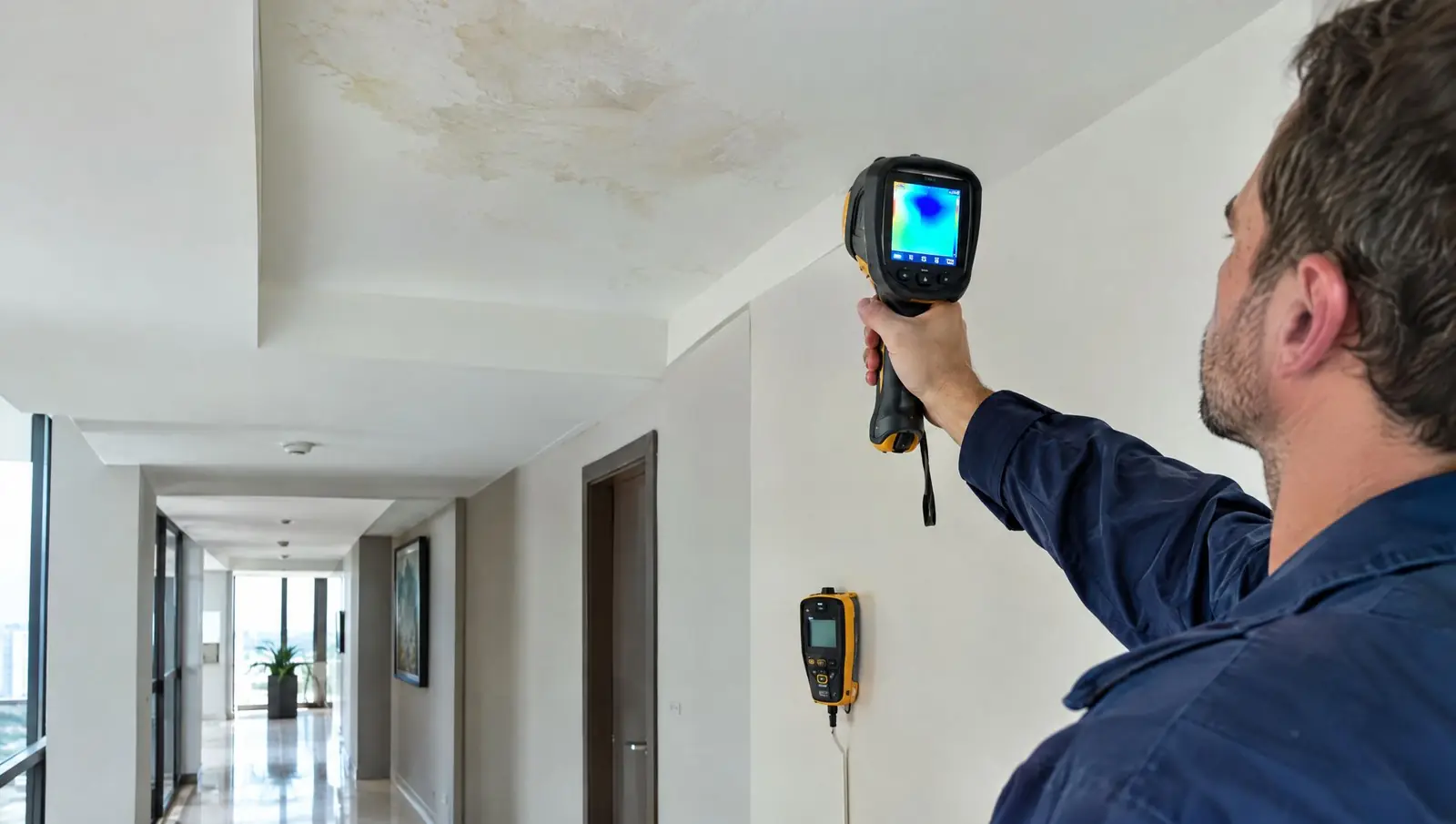
We combine moisture meters, thermal imaging, acoustic detection and pressure testing of supply lines to isolate the leak. For envelope leaks, we also check balconies, windows, sealants and terraces. Where possible we confirm with water testing, spraying sections of the façade in sequence to reproduce the leak.
Once the source is found, we can repair it or hand the diagnosis to the plumber or consultant responsible, with photos and readings.
What does condo leak detection in Toronto include?
- Moisture mapping across walls, ceilings and floors
- Thermal imaging to reveal wet materials
- Pressure testing of supply and heating lines
- Acoustic detection of pressurized leaks
- Water testing of balconies, windows and façade joints
- Written findings with photos and recommended repair
Leaks we trace
Supply and drain lines
Leaks inside walls, riser connections and fixture shutoffs.
Balcony and envelope leaks
Water that enters through slabs, doors, windows and joints.
Recurring stains
Stains that return after repainting because the source was never found.
How condo leak detection works, step by step
Interview
Where, when and how often does the water appear?Scan
Moisture and thermal mapping.Test
Pressure and water tests to isolate sources.Confirm
Limited, targeted opening only where required.Report
Source, photos and recommended repair.
Why leaks are hard to find in a high-rise
The place where water appears is rarely the place where it begins. Pipes run inside walls, through floor slabs and along ceilings, and water follows gravity and surfaces. A drip on a ceiling may originate from a supply line that is several metres away, a fixture in the unit above, a leaking riser connection, a balcony drain or a window. Intermittent leaks that appear only during rain, showers or a particular appliance cycle add to the difficulty.
Opening walls to look for the source is invasive and often wrong. Non-invasive detection narrows possible locations first, so any opening is small and targeted. That saves cost and disruption, particularly in finished units.
Detection methods we use
No single method works for every leak. We select from several, and often combine them:
- Moisture meters. Non-invasive and pin-type meters map wet areas on walls, ceilings and floors.
- Thermal imaging. A thermal camera shows temperature differences caused by moisture and by hot-water or hydronic leaks.
- Acoustic detection. Sensitive microphones detect the sound of water escaping from pressurized pipes.
- Pressure testing. Isolating a line and monitoring pressure loss confirms whether it is leaking.
- Tracer gas or dye. Used selectively on drain lines and fixtures.
- Water testing of the envelope. Controlled spraying of balconies, windows and façade areas, one section at a time, to reproduce a leak.
- Borescope inspection. A small camera through a minimal opening to view inside walls and cavities.
Common leak sources in condominiums
Experience points to a short list of recurring sources. Supply line connections under sinks and behind toilets, failed fittings at washing machine and dishwasher hookups, and corroded shutoff valves are among the most common. Shower and tub leaks, including failed membranes and cracked grout lines, damage the unit below. Heating and cooling equipment, such as fan coils with blocked condensate lines, can produce unexpected water. Balcony slabs and door thresholds, window frames and exterior sealants let rainwater in, and the leak may appear weeks after it started. Common-element risers and sprinkler lines are less frequent but can cause large losses.
Identifying the source category helps determine who needs to act: owner, corporation or both.
What you receive after a leak investigation
You receive a written report that identifies the source or the most probable source, supported by photographs, readings and test results. It explains the path of water, the affected areas and the recommended repair. If the source is within the unit, we can carry out the repair or coordinate a licensed plumber. If the source is a common element, we provide the evidence for the property manager and the corporation's consultant or plumber. The report is also helpful for insurance claims and for resolving disputes about responsibility.
When to call early
Call at the first sign: a ceiling stain that grows, paint bubbling, a musty odour, a jump in the water bill, sound of running water when nothing is on, or damp baseboards. Early detection limits damage, avoids mold and often reduces repair cost significantly. For an active leak, shut off the water supply to the fixture or unit if you can, and call building management and us.
A walk-through example: tracing a ceiling stain
To illustrate the process, imagine an owner on the ninth floor who finds a brown ceiling stain above the bathroom door. The unit above, on the tenth floor, reports no problems. We start by mapping the stain with a moisture meter, which shows the damp area extends beyond what is visible and runs along the wall shared with the corridor. Thermal imaging shows a cool line running up the wall to the ceiling cavity, which suggests flowing water rather than condensation.
With permission from management, we inspect the unit above and test its bathroom. A pressure test on the supply lines to the shower valve shows a slow loss of pressure, pointing to a pinhole at a fitting inside the wall. A small inspection opening confirms it. The repair is done by a licensed plumber, the ceiling below is dried and repaired, and the report documents the source and timeline. Without this method, the owner might have repainted the ceiling or opened the wrong wall.
Envelope and balcony leak investigations
Leaks from the building envelope need a different approach because the cause is outside and the symptom is inside. We interview residents about weather patterns, since leaks that follow wind-driven rain from one direction point to a specific elevation. We inspect the exterior from the balcony, a window or a suspended platform, and check sealants, flashing, door sills, balcony drains and cracks in masonry or slabs.
Controlled water testing follows. Working from the bottom upward, we apply water to a defined area, such as a window perimeter, for a set time while an observer inside watches for entry. If nothing appears, we move to the next area. Testing from the bottom up avoids false results caused by water from higher up running down. Once a path is confirmed, we recommend a repair that addresses the cause: resealing, flashing, slab repair or waterproofing.
These investigations are often needed to resolve disputes between owners and corporations, because they provide evidence of where water entered.
Reporting and next steps
The report states what was tested, what was found, what could not be confirmed, and the recommended action. It is written for owners, property managers and insurers, with photographs and readings that support the conclusions. If more than one source is present, we say so. We can repair the leak, coordinate trades, or provide the report to the party responsible. Where the leak is minor and the source accessible, repair is often done during the same visit.
Questions to ask a leak detection provider
Not every provider uses the same methods. Ask:
- Which techniques will you use? A mix of meters, thermal imaging, acoustic and pressure testing is typical.
- Will you open my walls? Most work should be non-invasive.
- Can you test the building envelope? Rain-related leaks need water testing.
- What will the report include? Photos, readings and a clear conclusion.
- Can you repair the leak? One visit for detection and repair saves time.
- What if you cannot find it? A good provider explains next steps, such as monitoring.
The short version
Finding a leak starts with measuring, not demolishing. Moisture mapping, thermal imaging, acoustic and pressure testing, and controlled water testing of the envelope usually identify the source with limited opening. CondoWorks reports the cause with evidence, so the right party can repair it, and so you avoid repeating drywall repairs under a leak that has never been stopped.
Condo leak detection across the Greater Toronto Area
We take leak detection projects in North York, Mississauga, Markham and across the rest of Toronto and the Greater Toronto Area. Related services you may need alongside this one: water damage restoration, condo mold remediation, balcony restoration, balcony waterproofing and storm damage repair.
Ready to start? Request a free assessment, learn about CondoWorks or check our service areas.