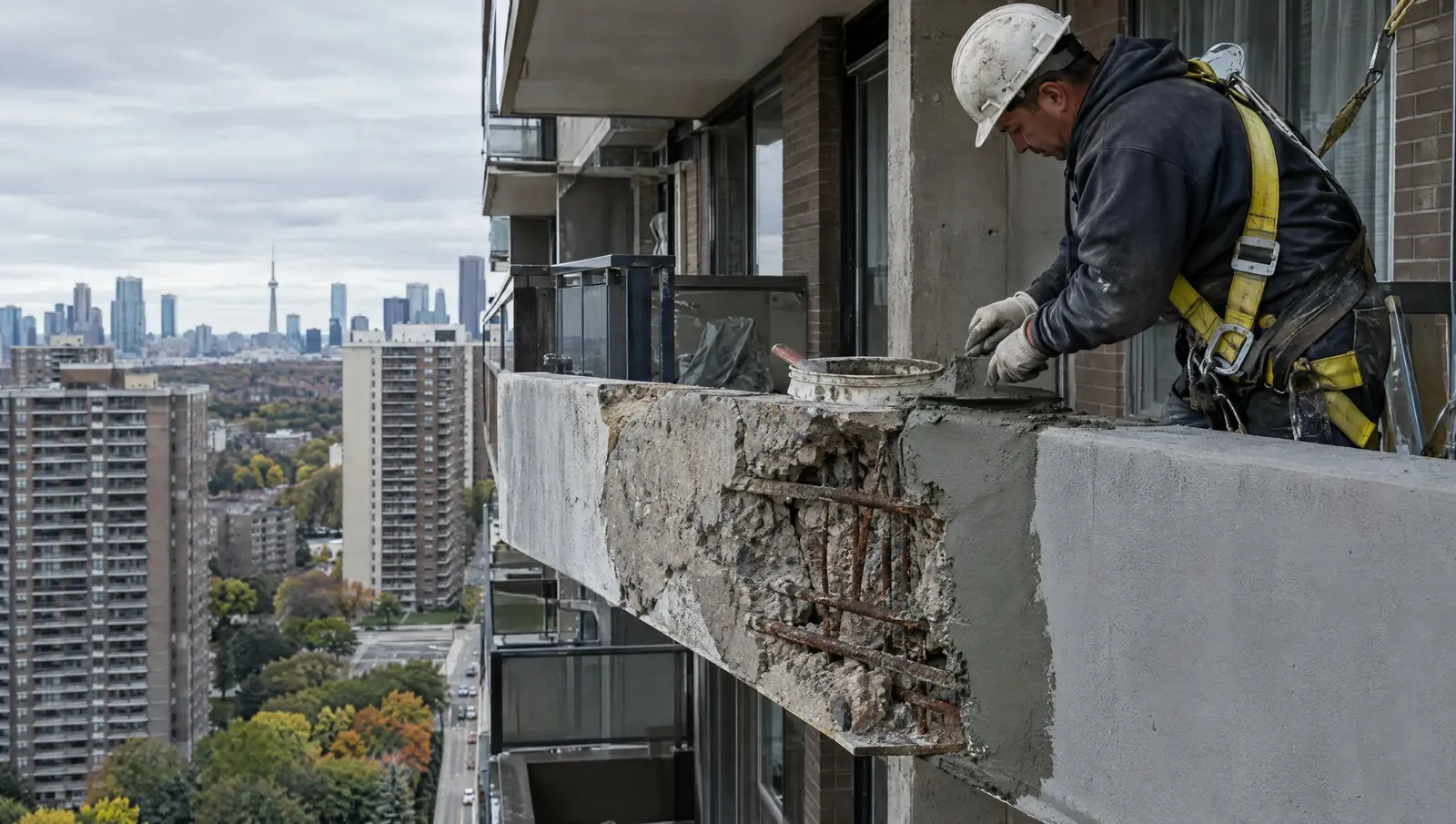
Balcony restoration in winter is mostly planning work. Surveys, engineering design, specifications, tendering, approvals and material orders can all continue in cold weather, while waterproofing membranes and repair mortars generally need mild, dry conditions and should be installed within the temperature limits on the product data sheet. For a condo board, winter is the right time to line up a spring start.
Key takeaways
- Planning work does not depend on temperature: condition surveys, engineering reports, drawings, specifications, budgets, tenders and contractor selection can all happen between November and March.
- Membranes, coatings and repair mortars have minimum temperature and moisture limits. Read the product data sheet and the engineer's specification rather than relying on a general rule.
- Cold-weather installation is sometimes possible with heated enclosures and temperature control, but it adds cost, complexity and risk, so many boards schedule the weather-sensitive steps for spring.
- A board that tenders in winter can award in early spring and mobilize as soon as conditions allow, instead of losing the first part of the season to planning.
Can balcony restoration be done in winter?
Part of it can. Balcony restoration is not one task. It is a sequence of steps, and some of them depend on the weather while others do not. The steps that involve people, paper and decisions can run all winter. The steps that involve wet materials on an outdoor concrete slab are the ones that need mild, dry conditions.
That split is useful for a condominium corporation. A board that treats winter as the planning and tender season, and spring as the construction season, usually arrives at the first warm week with a contractor, a specification and a budget already in place. The rest of this guide shows which steps fall on which side of that line.
| Work | Winter? | Why |
|---|---|---|
| Balcony condition survey and engineering report | Yes, with limits | Close-up inspection and sounding are harder when slabs are snow-covered or iced. Underside and interior checks continue, and the engineer may defer some testing |
| Design, drawings and specification | Yes | Office work, not affected by weather |
| Budgeting, reserve fund review and board approvals | Yes | Meetings and documents |
| Tendering and contractor selection | Yes | Contractors have more time to price carefully off-season |
| Permits, submittals and material orders | Yes | Paperwork and procurement. Lead times can be long |
| Resident notices and scheduling | Yes | Better done early so residents can plan around balcony access |
| Concrete removal and some surface preparation | Sometimes | Depends on temperature, ice and the specification. Hazards and costs rise in cold weather |
| Concrete repair mortars and patching | Usually not | Materials have minimum temperature limits and need protection while they cure |
| Waterproofing membranes and coatings | Usually not | Substrate must be dry and above the product's minimum temperature |
| Railing and guard work | Sometimes | Depends on the anchorage method and the slab condition around the posts |
These are general patterns, not rules for your building. The engineer's specification and each product's data sheet decide what is allowed, and they take priority over any general guide, including this one.
What work can continue in cold weather?
Most of the work that determines whether a balcony program goes well happens before anyone mixes a bag of repair mortar. All of it can proceed in winter.
- Condition surveys. A balcony restoration program starts with knowing what condition each balcony is in. Visual checks of slab undersides, door thresholds, railing posts and drains can continue, although snow and ice on the slab surface limit what can be seen and tested from above. Our guide to spalling and rust stains on condo balconies explains what an engineer looks for.
- Engineering design and specification. The engineer turns the survey into repair details, a scope and a written specification. This is the document every bidder prices, so time spent here reduces change orders later.
- Budgeting and approvals. The board checks the reserve fund study, confirms funding and decides how to phase the work. If a special assessment is possible, residents need notice early. Our guide to the reserve fund study shows where balcony work normally sits in the plan.
- Tendering and contractor selection. Boards can issue the tender, hold site walks where access allows, compare bids and check references. Our contractor vetting checklist covers WSIB clearance, insurance and bid comparison.
- Permits, submittals and ordering. Where the work needs a building permit or the engineer needs product submittals reviewed, that paperwork can be finished during winter. Ordering railings, glass or specialty materials early avoids waiting at the start of the season.
- Resident communication. Telling residents what is planned, when balconies will be out of use and what they must remove is easier in winter, when balconies are not in daily use.
What work needs mild, dry conditions?
Concrete repair and waterproofing are the two steps that depend heavily on temperature. Repair mortars, bonding agents, primers, membranes and coatings are chemical or cement-based products. They cure properly only when the surface and air are within the limits the manufacturer sets, and they need to stay dry while they do. A product applied outside its limits may not bond or cure as designed, and the failure often does not show until months later.
Because limits differ between products, do not rely on a single number for all balcony materials. Ask your contractor and engineer for the data sheet of each product in the specification and read the minimum and maximum temperatures, the moisture requirements for the substrate, and the protection needed after application. Our page on balcony waterproofing describes the systems involved. Different membranes and coatings have different application windows, which is one reason the specification names them.
- Surface temperature, not only air temperature. A slab can be colder than the air in the morning. Data sheets usually refer to the substrate as well as the air.
- Moisture and frost. Frost, ice or dampness in or on the slab can prevent a bond. A sunny afternoon does not guarantee a dry slab.
- Curing time. Many products must be protected from freezing while they cure. A mild day followed by a cold night can matter.
- Daylight and working hours. Short winter days leave less time for application, cure and cleanup.
Is cold-weather construction ever done?
Sometimes. Contractors can use heated enclosures, temporary heat, insulated blankets or low-temperature products to work in cold conditions, and concrete work in winter is a recognized practice with its own guidance. On a high-rise balcony it is harder than on the ground. Enclosing a balcony on the twentieth floor, heating it safely and keeping it dry adds cost and introduces fire, ventilation and wind concerns. Wind loads on temporary enclosures and the safety of working at height in ice and snow are real considerations.
For those reasons, many boards put the weather-sensitive steps in the warm season and use the cold season to prepare. If an urgent repair cannot wait, for example a damaged guard anchorage, the engineer and contractor can decide together whether a safe temporary measure or a winter repair is appropriate. Contractors working at height must also follow the Construction Projects regulation and related fall protection requirements, which apply in every season.
What should you do about hazards over winter?
The more urgent winter question is often safety rather than scheduling. Water gets into damaged slabs, freezes and expands. Our guide to freeze-thaw damage on condo exteriors explains how that makes cracks and spalls worse over the season.
Block off anything that could fall
If a balcony has loose or spalling concrete, restrict access to it and to the area below. Tell the property manager the same day.Keep drains clear
Standing water that freezes on a slab speeds up damage. Ask residents to keep drains clear of leaves and debris, and to report ponding.Avoid rock salt on balcony slabs
De-icing salt carries chloride, which is a known cause of reinforcing steel corrosion. Boards often ask residents to use alternatives or to shovel instead.Report new damage with photos
Residents who see new cracks, rust stains or loose railings should send dated photos to the property manager so the engineer can add them to the survey.Do not patch or paint in the cold
Patching in freezing weather rarely lasts and can hide the problem. Wait for the engineer's direction.
What does a winter planning calendar look like?
This calendar shows a typical sequence for a Toronto-area condo that wants to start work in spring. Dates move with the building, the size of the program and the weather, so treat it as a template for your own schedule, not a promise.
| Period | Step | Who |
|---|---|---|
| November to December | Commission or update the balcony condition survey. Photograph new damage. Confirm the budget source | Board, property manager, engineer |
| December to January | Engineer prepares the report, drawings and specification. Board reviews phasing and the reserve fund plan | Engineer, board |
| January to February | Issue the tender and hold the site walk. Contractors ask questions and submit bids | Engineer, property manager, bidders |
| February to March | Compare bids, check WSIB clearance, insurance and references. Interview the finalists | Board, engineer |
| March | Award the contract. Sign it with change order and payment terms. Order long-lead materials. Send resident notices | Board, contractor |
| Late March to April | Pre-construction meeting. Submittals reviewed. Mobilize when conditions allow and the product limits are met | Contractor, engineer, property manager |
| Spring and summer | Repair, waterproofing, railings and final review, phased by balcony or by floor | Contractor, engineer |
If your building has a lot of balconies, the board may split the work across more than one season. The engineer's phasing plan, and the reserve fund study, show how to spread cost across budget years. Our guide to balcony restoration vs replacement explains how engineers decide which slabs can be repaired and which should be replaced.
How do you get ready for a spring start?
- Have a signed contract before the thaw. Contractors schedule their crews months ahead. Awarding in March puts you in the queue.
- Confirm access and logistics. Elevator booking, material staging, parking for trucks and protection for common areas are easier to settle in advance.
- Tell residents what they need to do. They will need to clear their balconies and plan for loss of use. Early notice reduces complaints.
- Agree how weather delays are handled. The contract should say what happens when a cold snap or rain stops work, including how the schedule is adjusted.
- Plan for review points. The engineer normally inspects key steps such as concrete repair and membrane installation before they are covered.
How CondoWorks can help
CondoWorks restores balconies and exteriors on condominium buildings across Toronto and the GTA. Over winter we can walk the balconies with your property manager, document what we see, explain the likely repair approach and help the board understand what a spring program would involve. Where structural questions come up, we work alongside the corporation's engineer. To arrange a site visit, request a free assessment, or read about our wider condo restoration services.
This page is general information. Product limits, structural conditions and safety depend on the individual building, so rely on the engineer's specification and the manufacturer's data sheets for decisions about your balconies.
Winter balcony restoration: common questions
Sources and further reading
- Ontario Regulation 213/91: Construction Projects (Ontario e-Laws)
- City of Toronto: Building Permits
- Canadian Condominium Institute: Maintenance and Repairs
- Iowa State University: Evaluation of non-corrosive deicing materials and treatments (TR-471)
- Condominium Act, 1998 (Ontario e-Laws)