
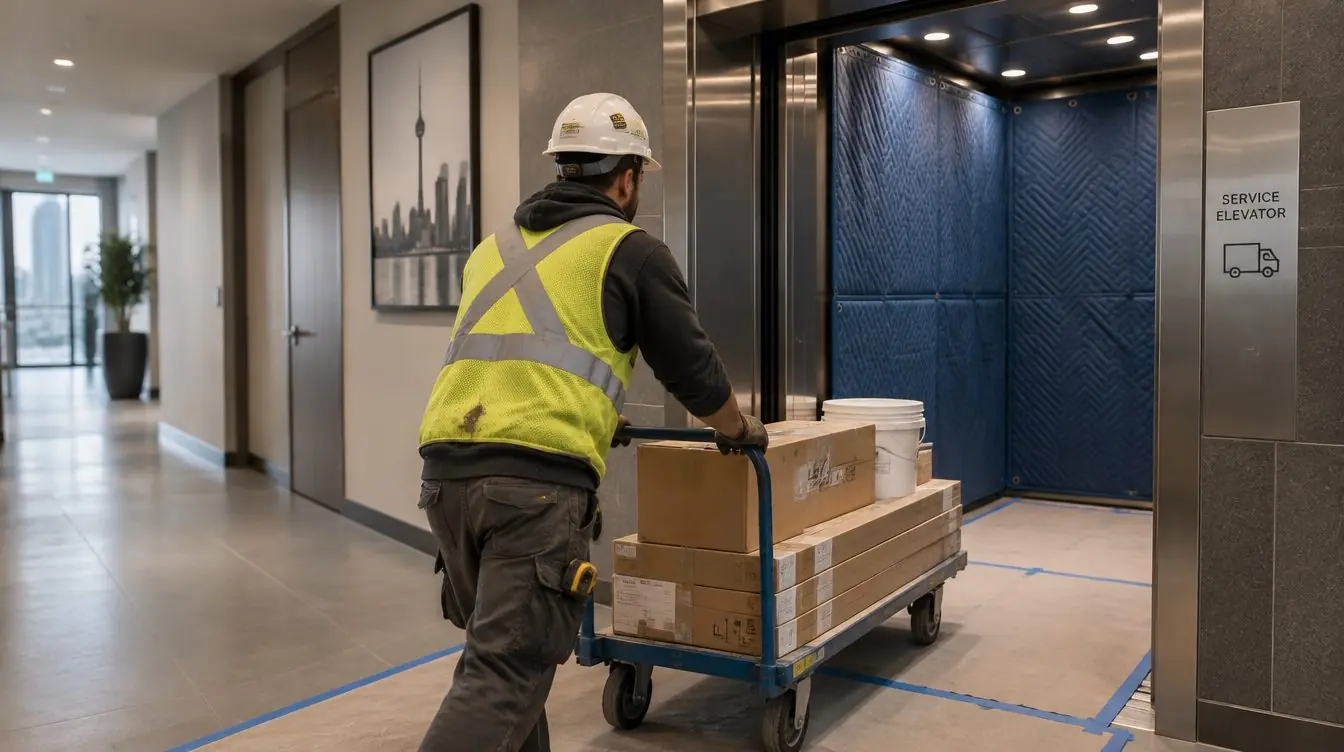
Condo renovation rules for a suite renovation usually cover five things: how and when you may book the service elevator, which days and hours work may happen, how corridors and common areas must be protected, how debris leaves the building, and what deposits and insurance the corporation requires from the owner and the contractor. The exact rules live in your corporation's declaration, by-laws and rules, and they differ from one building to the next, so treat this guide as a map of what to look for, not a list of what your building requires. Approval is a separate topic, covered in our guide to the approval process. This article focuses on the day-to-day rules that govern the work once approval is in hand.
Key takeaways
- Rules vary by corporation. The declaration, by-laws and rules, plus any renovation agreement you sign, are the only authority for your building. The property manager can confirm which version is current.
- Most buildings make owners book the service elevator in advance, in set blocks, often with a pad installed before use. Book early, because blocks fill quickly and a missed slot can push a delivery by days.
- Work hours are set by the corporation and by the City of Toronto noise by-law. The stricter of the two applies in practice, and noisy tasks such as demolition may be limited to narrower windows.
- Deposits, insurance certificates and a WSIB clearance are common conditions. Ask what is refundable, what it is held against, and what triggers a deduction before you sign.
Where do condo renovation rules actually come from?
Condo renovation rules in Ontario come from layers, and it helps to know which layer you are reading. The Condominium Act, 1998 sets the framework and gives corporations the power to make rules and by-laws about the use of the units and common elements. The corporation's declaration is the founding document for the building and often says what an owner may or may not change. By-laws and rules then fill in operating detail, such as elevator use, moving hours and conduct on the property. Finally, many corporations ask owners to sign a renovation or alteration agreement that pulls the key conditions for one project into a single document.
Because each corporation writes its own documents, one tower may allow a four-hour weekday elevator block and another may allow two, and one may require a deposit and another may not. That is why every statement below is a pattern, not a promise. If you are still at the stage of getting permission to start, our guide on the condo suite renovation approval process walks through board approval, agreements and permits. This article picks up after that point and covers the practical rules for running the job inside an occupied building.
Two other sources matter in Toronto. The Ontario Building Code and the City of Toronto decide whether a permit is needed and what safety rules apply, and the City's noise by-law sets the outer limit for construction hours. The corporation can be stricter than the City, but it cannot be looser. If you want a broader view of how a project moves from planning to close-out, our condo suite renovation service page describes how we sequence suite work under building rules.
How does elevator booking work?
Elevator rules are the ones that surprise owners most, because the elevator is shared by every resident and by every other contractor in the building. In a high-rise, almost all materials, tools, workers and debris move through one service or freight elevator, so corporations manage it as a scarce resource.
Typical elements include a booking system, often through the property manager or concierge, with a minimum notice period. Blocks are commonly set in fixed windows, and a block may cover a delivery, a debris run or a move, not an open-ended day. Many buildings require the cab to be padded before use, and some charge a refundable fee or deduct from a deposit if the pads are not installed or the cab is damaged. A few require building staff or a security guard to supervise the elevator while it is reserved, and some do not allow trades to use the passenger elevators at all.
Practical planning points that save time:
- Book the first delivery before you set a start date. Cabinets, flooring and fixtures often arrive on a fixed truck schedule, and the loading dock and the elevator both have to be free at the same time.
- Ask about dock and truck rules. Loading dock hours, maximum vehicle height and how long a truck may stay are separate rules from the elevator.
- Know the cancellation rule. Some buildings release a block if the crew is more than a set number of minutes late, or charge for a no-show.
- Plan long items. Countertops, doors and glass may not fit a standard cab. Ask about cab dimensions and whether a second route exists.
- Keep a copy of every booking. If a dispute arises about a delay or a damage claim, written bookings help sort out who was where and when.
What work hours do condos allow?
Work hours are normally set in two places. The corporation's rules usually name the days and times that renovation work and noisy trades are permitted, and the City of Toronto's noise by-law, Municipal Code Chapter 591, sets limits on construction noise across the city. In general terms the City limits construction to daytime hours, with a later start on weekends and holidays, but the exact times and the exceptions change, so read the current by-law or check with the City before you plan a schedule.
In practice, condo rules are often tighter than the City's. Many corporations limit noisy work to weekday daytime windows, may ban it on weekends and holidays, and sometimes narrow it further, for example by keeping demolition and coring out of the early morning and the lunch hour. Quiet work such as painting or installing trim may be allowed over a wider window than breaking out tile. A building may also add quiet periods around exam seasons or ask for advance notice to neighbours before particularly loud tasks.
When you build a schedule, work backward from the narrowest window. If demolition is only allowed for a few hours a day, a bathroom gut that would take two days in a house may take four in a tower. That affects the contractor's price, the duration of the project and how long you live or do not live in the suite. Our step-by-step restoration process guide shows how sequencing, drying, trades and inspections fit together on a longer job, and the same logic applies to renovation.
What are the rules for protecting corridors and common areas?
Corridors, lobbies and elevators belong to the corporation, and a renovation crew uses them every day. Most buildings therefore require protection of the route from the loading area to the suite. Typical requirements include floor protection along the corridor, such as heavy paper, hardboard or similar covering taped in a way that does not damage the finish, pads on elevator walls and doors, corner guards at turns and a mat or tacky floor at the suite door so dust is not tracked out.
Dust control is the second half of the rule. Many corporations require the suite door to stay closed while work is in progress, some ask for sealed plastic or a zip wall at the entry, and some limit the use of the corridor for cutting or sanding. Others require air vents in the suite to be covered so dust does not enter the mechanical system, and ask that any work touching the ventilation be flagged to the manager. If your building has recently been renovated in the common areas, the corporation may be especially protective. Our guide on condo corridor renovation explains why boards care about those finishes and how common-area work is staged.
Ask the manager for a written list of what protection is expected and how it will be checked. A walk-through before work starts, with photos of the corridor, elevator and lobby, protects both the owner and the contractor if there is a later claim of damage.
How do debris, noise and building access work?
Debris rules deal with the part of renovation most people forget to plan: demolition creates a large volume of material in a building with no driveway. Buildings commonly require waste to leave in containers or bags small enough for the elevator, move down only in an assigned block, and go to an approved bin or dock area. Many do not allow trades to use the building's garbage chutes or compactors, and some forbid putting renovation waste in the regular waste room. Heavy or hazardous materials are a separate matter. Ask whether any material may need special handling before demolition begins, and if the suite is older, whether testing is expected before disturbing finishes.
Noise rules go beyond hours. Some corporations require certain trades to use dust-collecting tools, or limit hammer drills and saws to narrow windows. Hard flooring is the most common source of complaints after a project ends, so many declarations or rules require underlayment that meets a stated sound performance, and some require a sound test or product data before installation. Ask for the standard in writing and keep the product sheets, because a later neighbour complaint will turn on them.
Access rules cover who may enter the building and how. Trades are commonly required to sign in at the front desk, wear identification, and be on a list supplied in advance. Keys, fobs and parking for trade vehicles are usually controlled, and some buildings require security or staff presence for after-hours access. The property manager is the contact for all of this, and a short pre-construction meeting with the manager, the owner and the contractor is often the quickest way to turn rules into a plan. For more on how managers coordinate this, see restoration for property managers.
What deposits and insurance are usually required?
Deposits are how corporations manage the risk that a renovation damages common elements or breaks the rules. A corporation may require a security deposit, sometimes separate amounts for elevator use, moving and the renovation itself, or may ask the owner to sign a document accepting responsibility for damage. The amount, whether it is refundable, and what it is held against are set by the corporation, and they differ. What matters for an owner is to understand three things before paying: what the deposit covers, how a deduction is decided, and when it is returned.
Insurance conditions usually apply to the contractor and sometimes to the owner. Commonly requested items include a certificate of commercial general liability insurance naming the corporation as an additional insured, proof of WSIB coverage or a clearance certificate, and a list of the trades who will be on site. An owner may also be asked to confirm that their own unit owner's policy covers improvements and liability. Our guide to contractor onboarding documents lists what a corporation typically collects and why, and you can use it to prepare your contractor before the manager asks.
Under the Condominium Act, 1998 the corporation and the owner each have responsibilities for damage that happens in or around a unit, and the rules about chargebacks and deductibles can matter if a renovation causes a loss. This is a legal question that depends on your documents and your insurance, so confirm it with the corporation's lawyer, your own lawyer or your insurance broker.
Condo renovation rules checklist
Use the table below as a list of questions to put to the property manager before you set a start date. It is a pattern list, not a requirement list.
| Topic | What buildings commonly set | What to ask the manager |
|---|---|---|
| Elevator booking | Advance booking in fixed blocks, padded cab, sometimes staff supervision | How much notice, how long is a block, what happens on a late arrival or cancellation |
| Loading dock | Set dock hours, vehicle size limits, time limits on trucks | Is a separate dock booking needed, and who meets the truck |
| Work days and hours | Weekday daytime windows, narrower for noisy work, weekends and holidays limited or banned | Which tasks count as noisy, and are there blackout periods |
| Corridor protection | Floor covering, wall pads, corner guards, door mats | Is a pre-work walk-through with photos required |
| Dust and ventilation | Suite door kept closed, sealed entry, vents covered | Is a zip wall or air scrubber expected, and who checks it |
| Debris removal | Bagged or bin debris, assigned elevator block, no chutes | Where does waste go, and who supplies the bin |
| Noise and flooring | Quiet-hours rules, underlayment performance requirement | What sound standard applies and what proof is needed |
| Access and security | Sign-in, ID, trade lists, fob control | How is the trade list submitted and updated |
| Deposits | Refundable deposit or fee for elevator, move and renovation | What it is held against, how a deduction is decided, when it is returned |
| Insurance and WSIB | Liability certificate naming the corporation, WSIB proof | What coverage limits and wording are required |
What common mistakes cause delays and disputes?
- Booking the contractor before reading the rules. A quote built on an eight-hour working day can be wrong if the building allows far less noisy time.
- Assuming a verbal answer is enough. Ask for the rules, the renovation agreement and the booking policy in writing, and keep copies.
- Forgetting the neighbours. A short notice to adjacent units, even where not required, often prevents complaints that lead to a stop-work request.
- Skipping the pre-work photos. Without a record of the corridor and elevator beforehand, a damage claim becomes one person's word against another's.
- Treating the deposit as a formality. If rules are broken or damage occurs, deductions come from it. Know the process before work begins.
- Letting insurance paperwork lag. Many managers will not release the first elevator booking until the certificates arrive, which can delay a start by weeks.
How CondoWorks fits in
CondoWorks works inside occupied condominiums and is used to building rules: elevator blocks, padded cabs, protected corridors, bagged debris and documented close-out. We are a contractor, not a lawyer, so we do not interpret your declaration or by-laws, but we can read the rules with you, build a schedule around them and prepare the insurance and WSIB paperwork a manager will ask for. If you are planning a suite renovation, send us the building address and the rules package if you have it.
Sources and further reading
- Condominium Act, 1998 (Ontario e-Laws)
- O. Reg. 48/01 under the Condominium Act (Ontario e-Laws)
- City of Toronto Municipal Code Chapter 591: Noise
- Ontario Regulation 332/12: Building Code (Ontario e-Laws)
- Canadian Condominium Institute