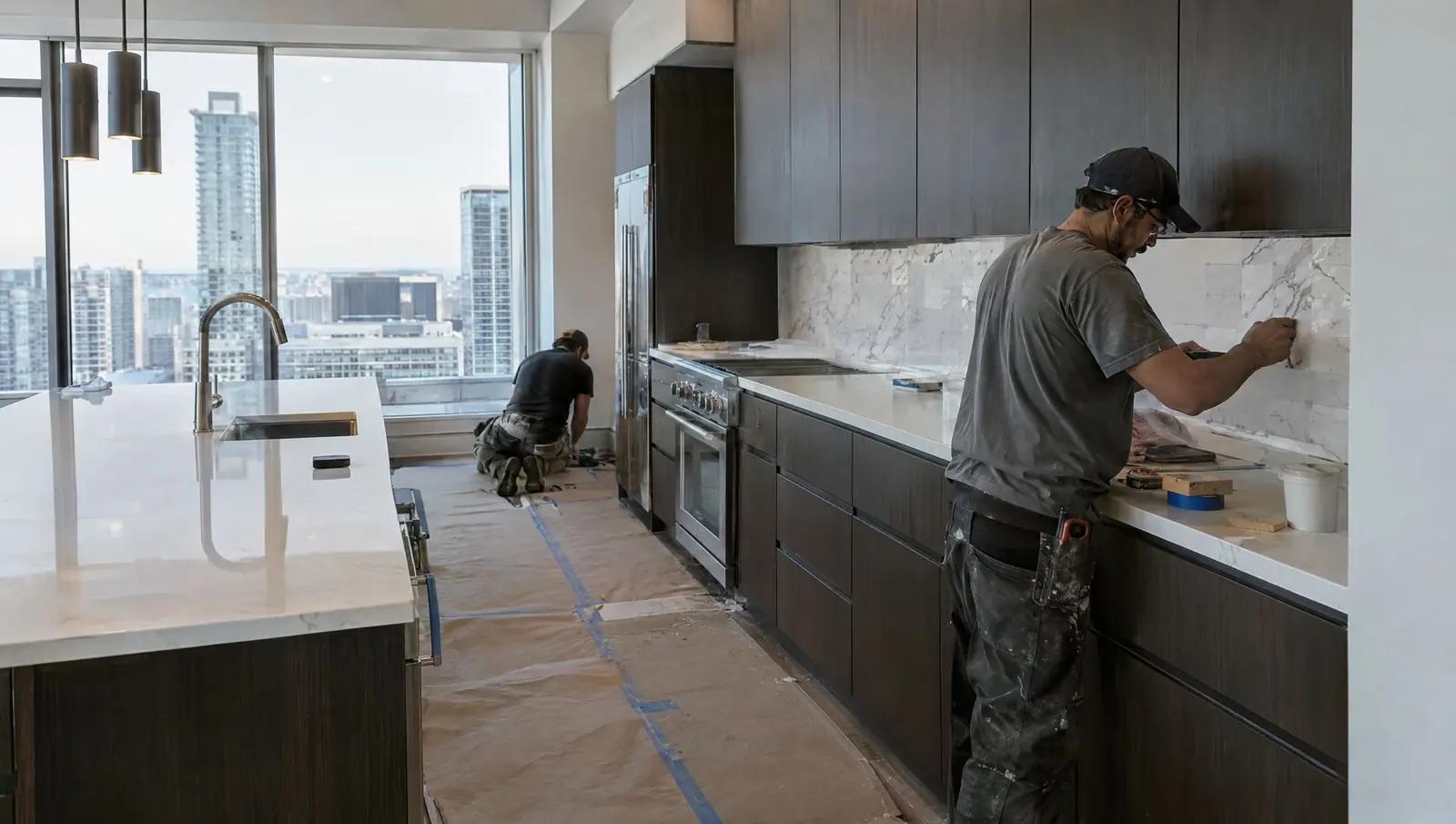
Condo suite renovation approval in Ontario usually starts with your corporation's declaration, by-laws and rules, and then moves through board approval, a written alteration or renovation agreement, contractor paperwork, and a building permit where the work requires one. Rules vary by corporation, so the only reliable starting point is the documents for your own building and a conversation with the property manager before anything is booked or demolished.
Key takeaways
- Read the declaration, by-laws and rules first. They decide what an owner can change inside a unit, what counts as a common element, and what needs the board's consent.
- Work that touches common elements, structure, plumbing stacks, electrical risers, windows, balcony doors or neighbours often needs board approval and a written agreement. Cosmetic work often does not, but the rules can say otherwise.
- Corporations commonly ask for contractor insurance, WSIB clearance, a work schedule, a deposit and proof of any permit before the first day of work.
- A building permit is separate from corporation approval. A unit owner may need both, and the board's approval does not replace a permit.
What is the approval process for a condo suite renovation in Ontario?
In broad terms, an owner checks the corporation's governing documents, asks the property manager what is required, submits a description of the work, receives approval from the board where it is needed, signs an agreement, provides the contractor's paperwork, and books the elevator and any other building resources. Where the work needs a permit, the owner or contractor also applies to the municipality. Work starts only after both the corporation and, where required, the city have approved it.
The details are set by each condominium corporation. The Condominium Act, 1998 and its regulations provide the framework, and the declaration, by-laws and rules fill in the specifics. This guide describes the steps boards, managers and owners commonly follow, but it is not legal advice, and your corporation's documents govern. For a project that goes beyond cosmetic updates, see our condo suite renovation service.
Where do you start? The declaration, by-laws and rules
Start by getting the corporation's governing documents. The property manager can provide them, and owners usually receive them when they buy. Three documents matter for renovations.
- The declaration. It describes what belongs to the unit and what is a common element. That distinction decides whether an owner can change something without the corporation's consent. Items such as windows, balcony doors, exterior walls and structure are often common elements, even if they are inside the suite.
- The by-laws. These set out how the corporation operates, and can include requirements for alterations, insurance and notice.
- The rules. Rules cover day-to-day matters, and for renovations they commonly set permitted working hours, noise, elevator use, protection of common areas, deposits and disposal of debris.
Read them with your plans in hand. If something is unclear, ask the property manager to confirm in writing how the corporation interprets it. Disputes about interpretation are easier to resolve before the work than after.
What needs board approval?
Whether work needs approval depends on what it changes. As a general pattern, the more the work touches shared systems, common elements or neighbours, the more likely approval is required.
| Type of work | Approval usually needed? | Why |
|---|---|---|
| Painting, wall finishes, trim, light fixtures | Often not, but notice may be required | Cosmetic and inside the unit. Rules about noise and hours still apply |
| Replacing flooring | Often yes | Many corporations have sound-control requirements for hard flooring because of noise to the unit below |
| Kitchen or bathroom renovation | Often yes | Plumbing, waterproofing and ventilation can affect neighbours and common systems |
| Moving or removing walls | Usually yes | May affect structure, fire separation, electrical or mechanical systems |
| Changes to plumbing stacks, risers or shared mechanical lines | Yes | Shared systems serve other units |
| Windows, balcony doors, exterior-facing changes | Usually yes | Often common elements, and tied to the building envelope |
| Electrical panel or wiring upgrades | Often yes, plus a licensed electrician and possibly an electrical authority notification | Safety and building systems |
This table is general. Your declaration may place a given item in a different category, and your corporation may require approval for work that another corporation does not. If the work affects common elements, the corporation may also need to decide whether it is a permitted owner change at all. Our guide to condo corridor renovation shows how common-area work is handled, which is the other side of the same question.
What is an alteration or renovation agreement?
When work needs the corporation's consent, the corporation commonly asks the owner to sign an alteration agreement, sometimes called a renovation agreement or similar. It records the work that was approved and the conditions under which it may proceed. Corporations often use a standard form and sometimes involve their lawyer.
Typical features include a description of the work and drawings, the owner's responsibility for the contractor, rules for hours, noise and protection, insurance requirements, a deposit or security, who pays for damage to common elements, and who is responsible for maintaining the altered area afterwards. Some agreements are registered or referred to in the corporation's records so they bind later owners. Read the agreement carefully before signing, and consider asking your own lawyer to review it, especially for structural or long-term changes.
What contractor paperwork will the corporation ask for?
Boards and property managers need to know who is working in the building and that the work is insured. The list varies, but commonly includes the following.
- Certificate of insurance. General liability insurance, often with the corporation and management company named as additional insureds, at a limit the corporation sets.
- WSIB clearance certificate. This confirms the contractor's WSIB account is in good standing. Our guide to hiring a condo restoration contractor explains WSIB clearance in more detail.
- Contractor and trade information. Business name, contacts, a list of trades expected on site, and licences where a trade requires one.
- Work plan and schedule. Start and finish dates, working hours, how debris will leave, how elevators and corridors will be protected.
- Emergency contact. A phone number the manager can call if something goes wrong during the work, such as a water leak.
Property managers often keep a checklist for this. Our page for property managers describes how we work with managers on condominium projects. Asking the manager for the checklist early saves a week of back-and-forth.
Do you need a building permit as well?
Possibly. A building permit is a municipal requirement, separate from the corporation's approval. The Building Code Act and the Ontario Building Code set out when a permit is required. Work that changes structure, removes or alters walls that may be load-bearing, changes plumbing or drainage, or alters fire separations commonly needs one. Cosmetic work often does not.
Check with the City of Toronto, or your own municipality, before assuming either way. The corporation may also ask for a copy of the permit before work starts, and may stop work that proceeds without one. A licensed designer or engineer may be needed to prepare drawings. Our guide on the condo restoration process shows how permits fit with scope, approvals and scheduling on a larger project.
What should an owner do before work starts?
Collect the declaration, by-laws and rules
Ask the property manager for the current versions and any renovation guidelines or forms.Describe the work and get drawings if needed
A clear scope and, for bigger projects, drawings from a designer help the board decide quickly.Submit the request to the property manager
Include the scope, drawings, contractor details and proposed schedule. Ask how long approval normally takes.Receive approval and sign the agreement
Read the conditions, and ask for clarification on anything unclear before signing.Provide the contractor's insurance, WSIB and schedule
Send the documents the manager lists and confirm that the corporation accepts them.Confirm any permit
Provide a copy of the permit if the work requires one.Book the elevator and loading dock
Reserve the times the rules require, and confirm deposits.Tell neighbours
A short notice to adjacent units reduces complaints. The corporation may require one.Keep records
Keep photos, approvals, receipts and the final inspection results. They matter at resale and if a dispute arises.
How long does approval take?
There is no standard timeline. A request that a property manager can approve under existing guidelines may be answered within days. A request that goes to the board depends on the board's meeting schedule, whether it needs the corporation's lawyer or an engineer to review drawings, and how complete the submission is. Ask the property manager how long the corporation normally takes, and build that time into your contractor's start date so a booked crew is not left waiting.
A complete package speeds things up. Include a clear description of the work, drawings where the work is more than cosmetic, the contractor's name and insurance details, and the dates you propose. Incomplete submissions are a common reason for delay, because the manager has to go back and ask for what is missing.
What if you rent the unit or own it as an investment?
Owners who rent their suite out should check whether the lease, the declaration and the corporation's rules affect when work can happen and who must be notified. Tenants generally cannot start renovations on their own authority. The unit owner remains the party responsible to the corporation for the work, the contractor and any damage that results, so the owner usually signs the approval request and the agreement.
How does insurance fit in?
Renovations change who is responsible for what if something goes wrong. Water damage that starts in a renovated suite can affect neighbouring units and common elements. The corporation's insurance, the owner's unit insurance and the contractor's liability coverage all play a role, and the declaration and agreement decide who pays which deductible. Before you start, tell your own insurer about the work and ask whether your policy covers improvements and betterments. Our guide to condo water damage insurance in Ontario explains how responsibility is commonly divided.
What if the board refuses or work started without approval?
If the board declines a request, ask for the reasons in writing and whether a modified proposal would be accepted. If work has already been done without required approval, the corporation may ask the owner to stop, restore the area, or apply retroactively. The Condominium Act and the Condo Authority of Ontario provide processes for certain disputes. Because the outcome depends on your documents, consider speaking to a condominium lawyer rather than relying on a general guide.
How CondoWorks can help
CondoWorks renovates and restores condominium suites in Toronto and the GTA, and we work with property managers on approvals, insurance paperwork, elevator booking, protection of common areas and scheduling. We can walk the suite, explain the likely scope and give the property manager what they need to review the request. Final approvals always rest with the corporation and, where needed, the municipality.
This page is general information, not legal advice. Rules differ between corporations, so rely on your declaration, by-laws, rules and the written instructions of your property manager.
Condo suite renovation approval: common questions
Sources and further reading
- Condominium Act, 1998 (Ontario e-Laws)
- Building Code Act, 1992 (Ontario e-Laws)
- Ontario Regulation 332/12: Building Code (Ontario e-Laws)
- City of Toronto: Building Permits
- Canadian Condominium Institute: Maintenance and Repairs
- Condo Authority of Ontario