
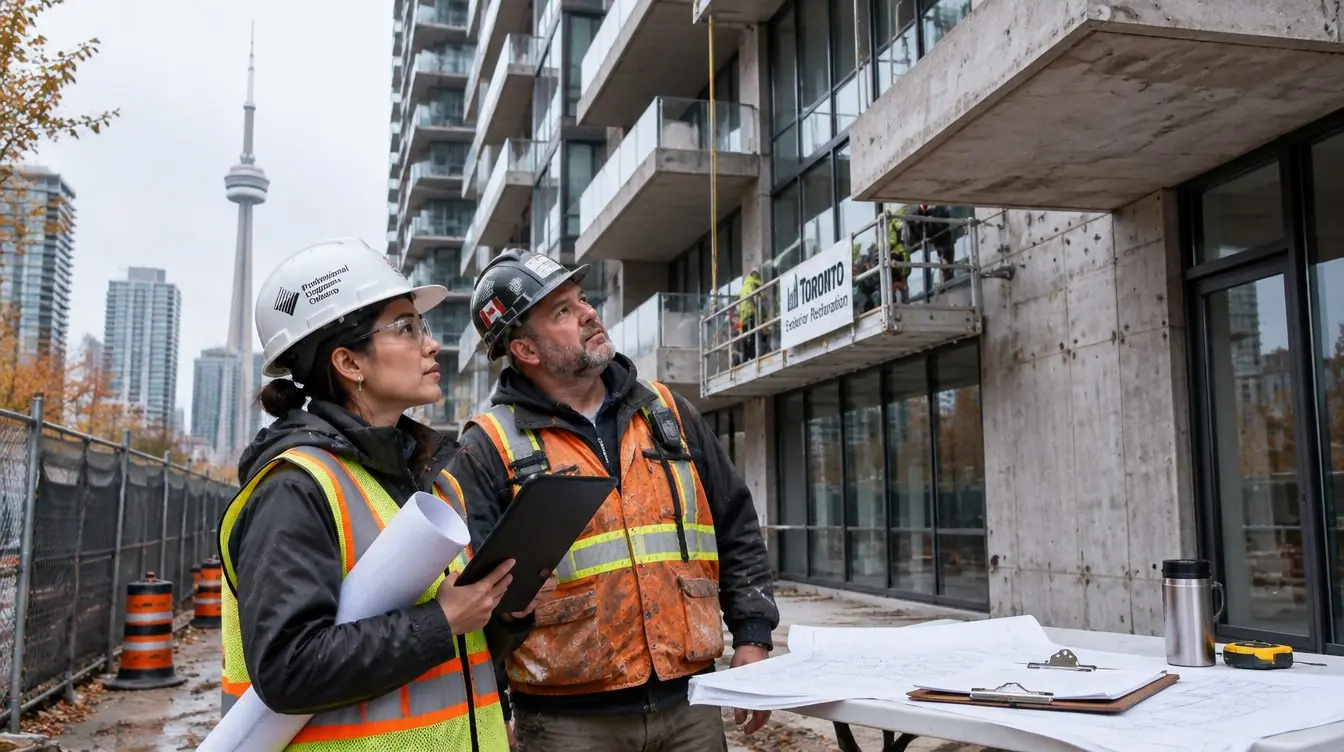
In condo restoration, the engineer and the contractor do different jobs: the engineer investigates the building, writes the repair specification and reviews the work on behalf of the corporation, and the contractor builds it, runs the site safely, keeps the schedule and documents what was done. Understanding condo restoration engineer vs contractor roles helps a board avoid paying twice for the same thing, or leaving a gap that nobody owns. This guide explains who does what, why independence matters, how consultant-led and design-build projects differ, and which questions a board or property manager should ask before signing. We are a restoration contractor, so weigh our view with that in mind.
Key takeaways
- The engineer's job is to find out what is wrong, decide what the repair should be, write it down in drawings and a specification, and review whether the work matches. The engineer works for the corporation.
- The contractor's job is to build to that specification, manage the trades, schedule and site safety, coordinate access with residents and hand over close-out documents.
- Independence matters because the person who writes the scope and checks the work should not profit from a bigger or looser scope. Many boards keep the two roles separate for that reason.
- Consultant-led (design-bid-build) and design-build are both used in Ontario. Neither is automatically right. The choice depends on the project's size, complexity and how much oversight the board wants.
Who does what in a condo restoration project?
A condo restoration project has at least three parties with distinct jobs: the corporation (the owner, acting through its board and usually a property manager), the consultant (typically a licensed professional engineer or an architect) and the contractor. Confusion starts when boards assume one party covers everything. A contractor who gives a free walk-through and a price has not done an engineering investigation. An engineer who writes a specification has not agreed to build anything, or to be on site every day.
The simplest way to remember it: the engineer answers what is wrong and what should be done about it, and checks that it was done. The contractor answers how to build it safely, when and with whom, and then builds it. The corporation decides, pays and holds the records. The steps in our guide to the condo restoration process show where each party sits at each stage, and this article goes deeper on the first two roles.
Not every job needs an engineer. A suite water loss, a smoke cleanup or a cosmetic corridor refresh is often handled by a contractor and the insurer without a consultant. The engineer becomes important when the work touches structure, the building envelope, waterproofing, guards, parking garage slabs or anything where the cause of the problem is not obvious. For larger planned programs, such as balconies or exterior walls, an engineer-led approach is the norm for most condominium corporations.
What does the engineer do on a condo restoration project?
A consulting engineer's work usually runs in four stages. The details vary by firm, so ask for the scope in writing.
Survey and investigation
The engineer reviews drawings and past reports, inspects the building, and may sound concrete, open up test areas, take cores or sample materials. The goal is to understand the cause and extent of the problem, not only the symptoms. For exterior work this is the same kind of condition review described in our condo facade inspection guide.Specification and drawings
The engineer turns the findings into a repair scope: which areas, which methods, which materials, which details at edges and drains. This document is what contractors price. A clear specification is what makes bids comparable.Tendering support
The engineer helps the board issue the tender, answers bidders' questions, compares bids and recommends an award. A good bid comparison looks at scope, exclusions, unit rates, schedule and the contractor's experience, not only the total.Contract administration and review
During construction, the engineer visits the site, reviews the work against the specification, reports deficiencies, reviews change requests and, depending on the contract, certifies progress payments. At the end, the engineer typically reviews close-out documents and confirms substantial completion.
The licence matters. In Ontario, the practice of professional engineering is regulated by Professional Engineers Ontario (PEO) under the Professional Engineers Act. A person who holds the P.Eng. designation is licensed to practise and is bound by a code of ethics, which, as we read it, includes duties to disclose conflicts of interest to the client. Engineers also seal their drawings and reports, which means they take professional responsibility for them. Before hiring, you can confirm a licence and any disciplinary history with PEO.
The engineer's role also overlaps with long-range planning. The same engineering firm, or another qualified one, may prepare the reserve fund study that tells the board when major repairs are likely to be due and how much to set aside. Our guide to the reserve fund study in Ontario explains how that document works, and how a repair specification refines the budget lines in the study.
What does the contractor do?
The contractor takes the specification and turns it into a built result. The work is more than labour and materials. A condo restoration contractor is responsible for how the job is run, and on an occupied building that includes a lot of coordination.
- Pricing and planning. Reading the specification, confirming quantities, identifying exclusions and proposing a schedule and logistics plan.
- Building the work. Concrete repair, waterproofing, sealants, glazing, flooring or whatever the specification calls for, using trained crews and the materials named in it.
- Site safety. Meeting the Occupational Health and Safety Act and Ontario Regulation 213/91 (Construction Projects), including fall protection, suspended access equipment and protection of residents and the public below.
- Schedule and trades. Sequencing the work so that balconies, hoists, elevators and loading areas are not blocked longer than planned, and coordinating subtrades.
- Resident and manager coordination. Access notices, noise windows, balcony clearing, parking and elevator bookings. Our page on restoration for property managers describes how this is run in practice.
- Documentation. Daily logs, photos, test results, submittals, warranties and a close-out package the corporation can keep.
A contractor does not decide independently what the repair should be on a project that has an engineer's specification. If the contractor finds something unexpected, such as more corroded steel than the survey predicted, the right step is to stop, document it and raise it with the engineer so that the change in scope is reviewed before it is priced and built. That discipline is part of what protects the board. For a practical look at what a board should collect from a contractor before work begins, see our list of condo contractor onboarding documents.
Engineer vs contractor: a role comparison
The table summarizes the usual split on a consultant-led project. Contracts can shift some items, so treat it as a starting point and confirm each line in the agreements.
| Topic | Engineer (consultant) | Contractor |
|---|---|---|
| Main question answered | What is wrong, and what should the repair be? | How do we build it safely, on time and to specification? |
| Who they work for | The corporation (under a consulting agreement) | The corporation (under a construction contract) |
| Investigation and testing | Leads it, interprets results, sets the scope | Supports access and opening-up; does not set the scope |
| Drawings and specification | Prepares and seals them | Reads, prices and builds to them; may prepare shop drawings |
| Pricing | Prepares an estimate and compares bids | Submits a bid based on the specification |
| Site safety and means and methods | Not usually responsible for the contractor's methods; may review certain designs | Responsible for safe work methods, crews, equipment and housekeeping |
| Schedule and trades | Reviews progress against the schedule | Plans and runs the schedule and subtrades |
| Quality review | Visits site, reports deficiencies, reviews tests | Self-checks, corrects deficiencies, provides records |
| Change orders | Reviews scope and cost reasonableness, advises the board | Raises the issue, prices it, performs approved changes |
| Payments | May certify progress payments, depending on the contract | Submits payment applications with backup |
| Close-out | Reviews documents and confirms completion | Provides warranties, records, clearances and as-built information |
Why does independence matter?
The engineer sets the scope and reviews the work. If the same company also profits from the scope and the construction, there is a built-in tension: a larger scope can mean more revenue, and a looser review can mean fewer corrections. That does not mean everyone who works under a combined arrangement behaves badly. It means the board loses an independent check, and a board relies on that check when residents ask hard questions or when a defect appears two years later.
An independent consultant is paid by the corporation for advice and review and has no stake in who wins the construction contract or how much the contractor earns. This is the setup many Ontario condominium corporations choose for balcony, garage and envelope programs. It also helps with tendering: when every bidder prices the same specification, the board can compare like with like. Our guide on how to hire a condo restoration contractor explains what to look for once the specification is ready.
Independence works in the other direction as well. A contractor should be free to tell the board when a specification looks unclear, incomplete or hard to build, and a good engineer will want to hear it. Healthy projects have a working relationship where each party can speak openly to the corporation, and where the engineer is the one who decides what is accepted.
Engineers have professional duties here. We read the regulation under the Professional Engineers Act as requiring practitioners to disclose actual or potential conflicts of interest to their clients, so a board is entitled to ask any engineer about relationships with contractors, suppliers and product manufacturers before signing.
Consultant-led vs design-build: how do they compare?
There are two common ways to organize a condo restoration project, and many variations in between.
Consultant-led (design-bid-build)
The corporation hires an engineer first. The engineer investigates, prepares the specification and runs a tender. The corporation then signs a construction contract with the chosen contractor, and the engineer reviews the work. This model gives the board a separate expert on its side, and bids are comparable because they follow the same documents. It usually takes longer at the front end because design and tender come before construction, and the board holds more contracts and coordination.
Design-build
The corporation signs one agreement with a contractor, or a contractor-led team, that covers both design and construction. The contractor's engineer prepares the design. This can shorten the schedule and give the board a single point of responsibility. The trade-off is less independence: the person judging the design works within the same commercial relationship as the person building it. Some boards address this by hiring a separate engineer as an owner's representative to review the design and the work.
| Factor | Consultant-led | Design-build |
|---|---|---|
| Number of main contracts | Two or more (consultant and contractor) | One main agreement, plus any owner's representative |
| Independent review of the work | Built in | Needs to be added deliberately |
| Bid comparison | Like for like, same documents | Harder, since each team proposes its own design |
| Front-end time | Longer | Often shorter |
| Best suited to | Large, complex or high-risk exterior and structural programs | Smaller or well-defined jobs, or where speed matters and oversight is arranged |
Neither approach is a guarantee. A weak specification can ruin a consultant-led project, and a poorly managed design-build can hide scope decisions. Ask your lawyer to review the contract form, and ask your insurer whether the structure affects coverage. If you need a place to start thinking about scope, our overview of condo restoration lists the main services and what each involves.
Who holds which legal responsibilities?
The following points are a general orientation, not legal advice. Responsibilities depend on the contracts, the project and the current law, so confirm them with the corporation's lawyer.
- The corporation. Under the Condominium Act, 1998, the corporation controls and maintains the common elements, which include most exterior elements. It also plans for major repairs through the reserve fund. Decisions about spending, contracts and changes to common elements run through the board, and some changes need owner notice or approval under the Act and the declaration.
- The constructor. Under the Occupational Health and Safety Act, the constructor is the party that undertakes a project for an owner, or the owner itself if no one else holds that role. The constructor carries significant duties for site health and safety. Boards should confirm in the contract who is the constructor and make sure that party has the capacity to carry out the role.
- Payment and holdback. Ontario's Construction Act sets rules for proper invoices, prompt payment and holdback, and the contract may name a payment certifier, often the consultant. Following these rules protects the corporation against lien claims and helps trades get paid on time.
- Permits and general review. Some projects require a building permit, and under the Ontario Building Code certain work needs general review by a registered architect or engineer. Whether a permit applies depends on the work, so ask the engineer and the City of Toronto building office.
- Records. The corporation should keep the report, specification, drawings, tender documents, change orders, certificates, test results and warranties. They are the corporation's evidence if a defect appears later, and the next engineer will use them.
Our article on the decision between balcony restoration and replacement shows these roles in a concrete case: the engineer's condition survey drives the decision, and the contractor then builds the option the board chooses.
What should a board ask?
These questions work for engineers and contractors alike, and the answers should be in writing.
Questions for the engineer
- What exactly is in your scope, and what is excluded? Who attends site meetings, and how often?
- Do you have any financial or business relationship with a contractor, supplier or manufacturer that could affect your advice?
- What experience do you have with buildings like ours, and who on your team will do the work?
- How do you handle unexpected conditions and change orders? Will you certify progress payments?
- What will the final report and close-out package contain?
Questions for the contractor
- Have you priced the engineer's specification as written? What did you exclude or assume?
- Who is the constructor under the Occupational Health and Safety Act, and who is your site supervisor?
- What is your schedule, and how will you protect residents' access, noise windows and balconies below the work?
- How do you document the work, and what will we receive at the end?
- How do you handle a condition that differs from the survey?
Questions for the board itself
- Is the money in the reserve fund or a special assessment, and has the board confirmed how the expense is approved?
- Have the lawyer and insurer reviewed the contract structure?
- Who is the single point of contact for residents, and who approves changes?
What common mistakes should boards avoid?
- Asking a contractor to define the scope for free and then treating it as an engineering report. A sales walk-through is useful for a first look, but it is not a substitute for an investigation.
- Hiring the engineer after the contractor is chosen. The specification should come first, so every bid is based on the same facts.
- Leaving the review role unassigned. If nobody is checking the work, the board is trusting the contractor's own inspection alone.
- Treating the engineer's estimate as the contract price. It is a planning number. Bids set the price.
- Skipping change-order discipline. Verbal approvals on a balcony lift do not hold up well later. Changes should be written, reviewed and priced before the work starts.
- Not asking who carries the safety role. The constructor question should be answered before mobilization, not after an incident.
How CondoWorks works with your engineer
CondoWorks is a contractor, and on projects with an engineer-prepared specification we price and build to it, flag unexpected conditions to the engineer in writing and provide a documented close-out. For smaller jobs or emergencies where no consultant is involved, we scope and document the work ourselves and tell you when we think an engineer should be brought in. If you are a board or property manager weighing how to structure a program, send us the building address and a short description. We will tell you what we see and how we would work with your consultant.
Sources and further reading
- Condominium Act, 1998 (Ontario e-Laws)
- O. Reg. 48/01 under the Condominium Act (Ontario e-Laws)
- Professional Engineers Act (Ontario e-Laws)
- Regulation 941 under the Professional Engineers Act (Ontario e-Laws)
- Occupational Health and Safety Act (Ontario e-Laws)
- Ontario Regulation 213/91: Construction Projects (Ontario e-Laws)
- Construction Act (Ontario e-Laws)
- Building Code Act, 1992 (Ontario e-Laws)
- Professional Engineers Ontario